How Many Bottles to Carry for a Road Race | Calculator
Gabriel Ricce
Lamorinda MBO Racing · USA Cycling Coach Level 3
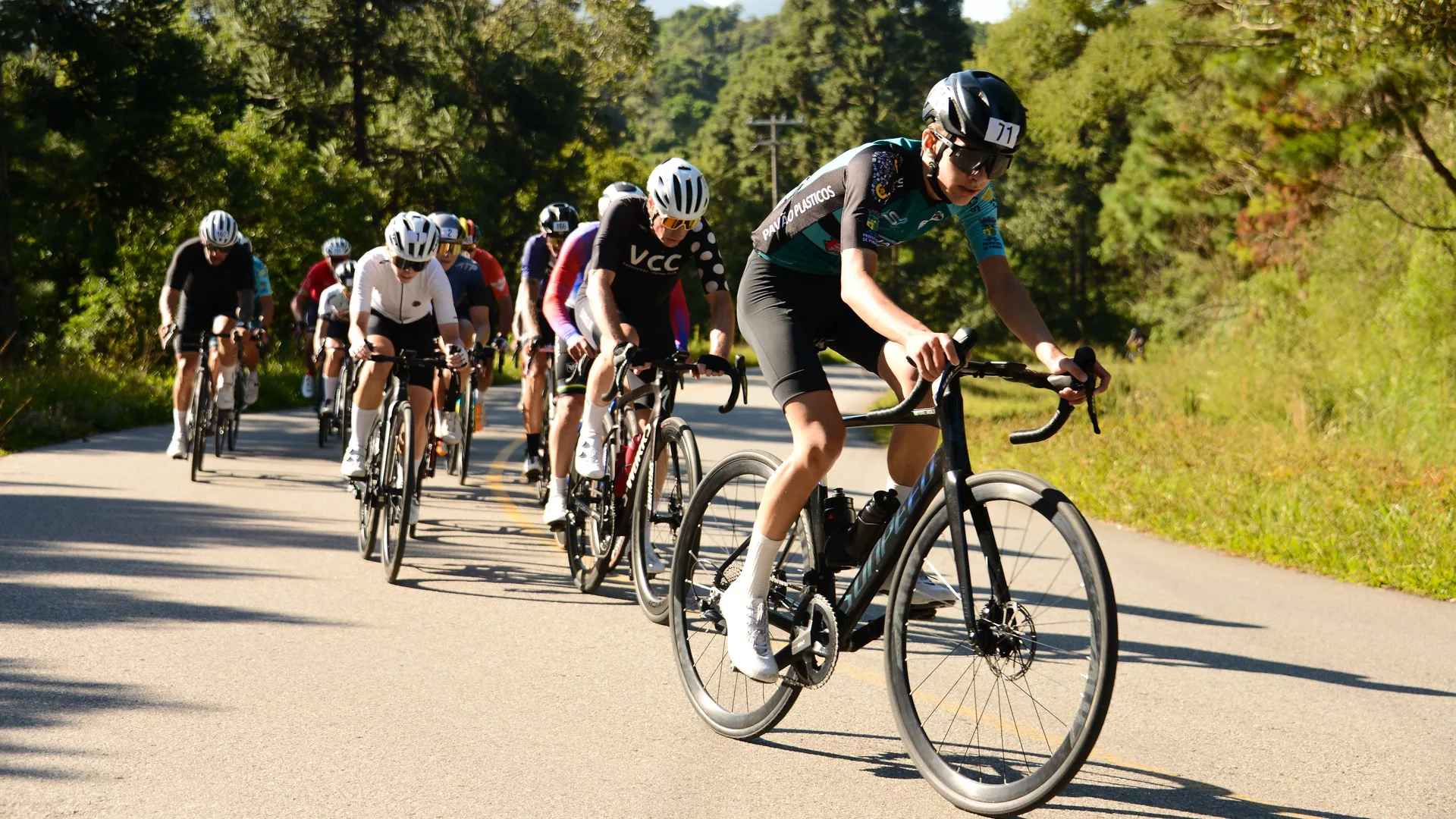
Hero photo by wal_ 172619 on Pexels · Pexels License.
Bottle count for a US cycling road race is a function of four variables: your measured sweat rate, race duration, the longest gap between feed opportunities, and the day's heat/humidity. Most criteriums need zero to one bottle. Most 60–120 minute road races need one to two. Longer or hotter races usually mean two bottles at the start plus planned handups, neutral support, or a feed-zone reset.
Why bottle count matters more than you think
Bottle count is not just a convenience choice. In a road race, it controls how consistently you hit your fluid, sodium, and carbohydrate targets while the pack is surging, cornering, or lining out in the wind. Under-carry and you gamble on missed handups, crowded feed zones, and long dry stretches. Over-carry and you add weight, create awkward handling, and waste cage space that could be used more deliberately.
Think in race windows, not only miles. Most cyclists do best with small drinks every 10–15 minutes, but road races rarely give you perfect timing. You may be pinned on the wheel before a climb, unable to reach down in a crosswind, or too far from the right side of the road when the feed zone appears. Two bottles give you more autonomy: one can carry carbohydrate and sodium, the other can stay lighter or plainer for hot segments. For a precise setup, use the bottle and gel planner to match fluid, carbs, gels, sodium, caffeine, and handup timing.
Heat and race dynamics magnify the stakes. In warm conditions, sweat rate climbs quickly; missing a bottle for 30–45 minutes can raise perceived effort and make the next attack feel far harder than it should. Conversely, starting with two bottles lets you skip a chaotic early feed, stay sheltered in the bunch, and use later support once the race has settled.
The best setup starts with your needs, then adapts to the course. Set your fluid and sodium targets, map the feed windows, and back into the minimum bottle count that lets you stay on schedule with minimal fiddling. Fewer misses, steadier fueling, stronger final laps or climbs.
Free: the Cycling Race Fueling Checklist
Turn this into a race-week plan: carbs, bottles, sodium, caffeine and feed-zone prep in one free PDF you can print or keep on your phone.
Start with the math: sweat rate → fluid need → bottle count
Forget guesswork — use your numbers.
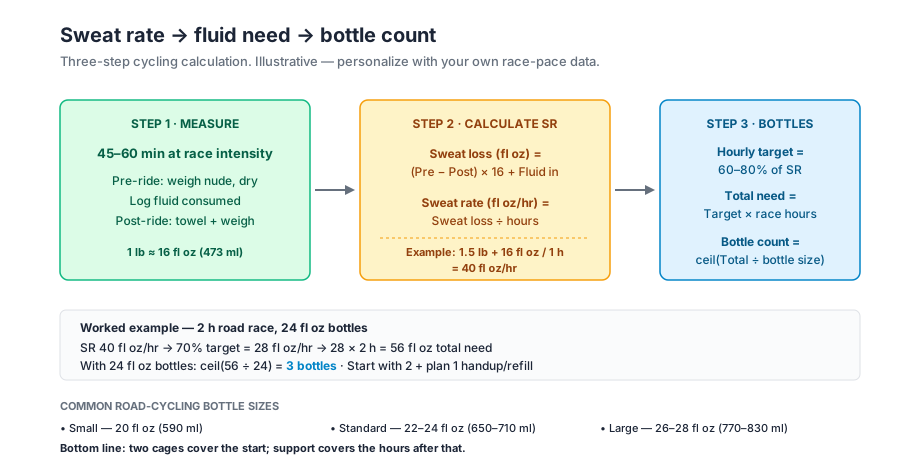
1) Measure your sweat rate (SR)
- Do a 45–60 minute ride at road-race intensity in similar weather. A hard group ride, race simulation, or threshold session works well.
- Towel off sweat before weighing. Weigh nude, dry, before the ride.
- Drink normally if you want, but measure exactly how much fluid you consume.
- After the ride, towel off, weigh nude again, and subtract any bathroom losses if relevant.
- Sweat loss (lb) = Pre (lb) − Post (lb) + Fluid in (lb). 1 lb ≈ 16 fl oz (473 ml).
- Sweat rate (fl oz/hr) = Sweat loss (fl oz) ÷ Duration (hr).
You can streamline this process with a sweat rate calculator for accurate results.
Example: You lose 1.5 lb in 60 minutes and drink 16 fl oz.
- Sweat loss = (1.5 × 16) + 16 = 24 + 16 = 40 fl oz.
- SR = 40 fl oz/hr.
2) Set your hourly fluid target
- Most cyclists can target roughly 60–80% of measured sweat rate in racing conditions.
- Start near 70% if the race is short or cool; move toward 80% when it is hot, humid, or longer than two hours.
- Do not chase 100% replacement if it causes sloshing or forces you to drink more than your gut can handle.
Using the example: 0.70 × 40 = 28 fl oz/hr target.
3) Convert to total race fluid need
- Total need (fl oz) = Hourly target × Race duration (hr).
- If you have reliable handups, team-car bottles, or neutral/feed-zone support, subtract the amount you can realistically collect.
Example: Two-hour road race, no reliable mid-race pickup:
- Total = 28 × 2 = 56 fl oz.
4) Translate to bottle count
Common road-cycling bottle sizes:
| Bottle | Volume |
|---|---|
| Small bike bottle | 20 fl oz (590 ml) |
| Standard bike bottle | 22–24 fl oz (650–710 ml) |
| Large bike bottle | 26–28 fl oz (770–830 ml) |
Bottle count = ceil(Total need ÷ Bottle size).
Examples:
- Need 56 fl oz. With 24 fl oz bottles: ceil(56 ÷ 24) = 3 bottles.
- Since most road bikes carry two bottles cleanly, that means two at the start plus one handup, team-car bottle, neutral bottle, or feed-zone pickup.
5) Adjust for course support and heat
- If feed support is reliable every 45–60 minutes, you can start with two bottles and exchange empties rather than carrying everything.
- If the race has no feed zone, bottle count is capped by your bike setup; use larger bottles and keep carbohydrate delivery realistic.
- Hot/humid? Your sweat-rate test may underpredict race demand. Add 10–20% and reassess in training.
- Cool weather? You may be fine at 60–70% of sweat rate, especially in races under 90 minutes.
For a streamlined calculation of hourly needs and bottle count, try the cycling hydration calculator.
Bottom line: Measure sweat rate, set a realistic hourly target, scale to race time, then match volume to bottle size and support. Practice in race-like sessions to confirm comfort, handling, and gut tolerance.
Adjust for US conditions: heat, humidity, elevation, wind
Heat (80–100 °F+): Expect higher sweat rates and faster sodium loss. A common hot-race pattern is one 22–24 fl oz bottle every 30–45 minutes, depending on body size, pace, and humidity. Start with cold bottles, include sodium from the first sip, and plan extra support before the hardest climb or exposed section.
Humidity (60–90%+): Sweat evaporates slowly, so you overheat sooner even if your jersey is soaked. Increase sodium concentration slightly, shorten sip intervals, and avoid overly concentrated carb bottles that sit in the gut. Use water for dousing if offered, but do not count it as hydration.
Dry heat (Southwest): Evaporation is rapid, so you may underestimate losses because clothing dries quickly. Stick to a time-based plan rather than thirst alone. Use enough sodium that you can retain what you drink, especially during long exposed races.
Elevation (Colorado, New Mexico, mountain towns): Drier air and increased ventilation drive fluid loss, and early altitude exposure can suppress thirst. Start slightly over-prepared, especially if the first feed is late. If you are traveling from sea level, avoid stacking aggressive caffeine with aggressive fluid goals until you know your gut handles it.
Wind: Headwinds increase effort and breathing rate; tailwinds reduce cooling. In crosswinds, drinking windows can be rare because both hands may need to stay settled. Take small sips before exposed sections instead of waiting until the gutter.
For more on tailoring hydration to specific race day weather and conditions, see race day weather and conditions.
Bottom line: Match bottle count to environment. Hot, humid, high, or windy races often demand an extra bottle, a more reliable handup plan, or stronger electrolytes. Test the setup before race day.
Feed zones and support: plan the gaps, not the averages
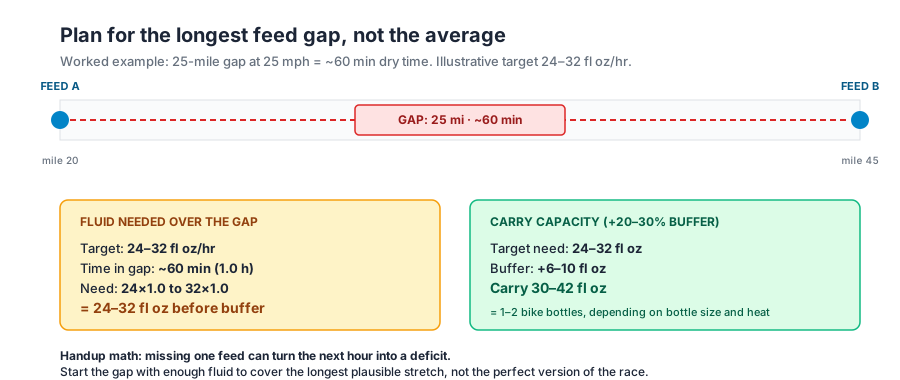
Most race guides list feed zones, neutral support, or team-car access by location. That is useful, but averages can mislead you. Plan for the longest dry stretch you might face, not the tidy mean. Map exact mile markers, likely speed, climbs, exposed roads, and whether the race allows personal handups.
Convert the longest gap into time. Example: a 25-mile stretch at 25 mph is one hour without a guaranteed bottle. If your race target is 24–32 fl oz/hr, you need roughly one to one-and-a-half standard bottles for that stretch, plus a buffer. If the same gap includes a long climb, slow dirt sector, or high heat, treat it as longer than the mileage suggests.
Bottle handups are not guaranteed. You can miss the bag, drop the bottle, hit the feed on the wrong side of the road, or be stuck following a move when you planned to grab. A small buffer is not overthinking; it is insurance against normal road-race chaos.
Decide your support tactics:
- No feed support: Start with the maximum clean bottle setup your bike and rules allow, usually two frame bottles.
- Neutral or official feed zone: Know exactly which side of the road it is on, what bottles/drink are offered, and whether discarding bottles is allowed.
- Team car or follow vehicle: Confirm category eligibility, service windows, and how often you can safely request bottles.
- Friend or team handups: Use high-contrast bottles, agree on the exact location, and practice the pass at speed.
For a step-by-step approach, check out the race fueling checklist to ensure your plan covers every gap.
Finally, rehearse. Do a race-pace group ride and simulate the biggest dry gap with your exact bottle setup. If you finish the segment with more than a small sip left, you are right-sized. If you are dry before the end, use larger bottles, add a support point, or lower the concentration so you can drink more comfortably.
Bike setup: where to carry without killing your aero
Your fastest bottle is the one you can drink from without losing position or confidence. Aerodynamics matter, but mass-start road racing also rewards simple, secure, one-handed access. Unless your specific event allows other systems, assume two frame cages are the default.
Best placements (fast-to-slower, context matters):
- Down tube cage: Usually low-risk and easy to grab. Many frames are designed assuming a bottle will sit here.
- Seat tube cage: Often the second standard bottle spot. Check access if your frame is compact or your bottles are oversized.
- Single behind-the-saddle bottle: Useful for longer events or solo road efforts, but make sure it is secure and easy to access before using it in a pack.
Higher penalty placements (use only if needed):
- Wide or staggered rear carriers: Can add drag and make bottle handling awkward. If you use one, keep it narrow, secure, and practiced.
- Bar-top or between-the-arms systems: Better suited to time trials, triathlon, or non-drafting events where rules allow them. Do not assume they are appropriate for a mass-start road race.
- Frame top-tube/strap-on mounts: Creates messy airflow and can interfere with knees, cables, or handling. Reserve these for unusual logistics.
Practical tips:
- Use one-handed access: practice grabbing, drinking, and replacing each bottle while holding a steady line.
- Match bottle shape to cage: rattling costs confidence, and ejected bottles can be dangerous.
- Keep tools under-saddle, in a frame bay, or in a pocket so prime cage space stays available for fluids.
- If you run two bottles, use down tube + seat tube first; add a secure rear option only if the event demands more capacity.
- Pre-label bottles by segment so you don't reach for the wrong one under pressure.
Fluids aren't equal: electrolytes and carb concentration
Two bottles can deliver totally different outcomes depending on what's in them. For road races, think in terms of electrolyte content and carbohydrate concentration (often shown as grams per 100 ml or percent). Both change how quickly fluid empties from your stomach and how well you maintain blood sodium.
| What to compare | Typical on-course drink | Athlete need / risk threshold | Action |
|---|---|---|---|
| Sodium | Neutral bottles vary widely | Sweat losses often 800–1,500+ mg/L (higher for salty sweaters) | Supplement with drink mix or salt capsules to close the gap |
| Carbohydrate concentration | Drink mix often 4–8% | 6–8% = comfortable starting range; 9–12%+ = GI risk for many riders | Cap normal bottles near 6–8%; if concentrated, chase with water |
| Osmolality | ~250–330 mOsm/kg (isotonic) | Hypertonic (>330) slows gastric emptying, especially in heat | Prefer iso or slightly hypotonic mixes on hot days |
| Bottle role | One-size-fits-all | Split roles: A = higher sodium; B = lower carbs for hot / hard segments | Label bottles by role and race segment before the start |
Electrolytes: Sodium is the priority because it supports fluid absorption and helps you retain what you drink. Neutral or event-provided bottles can vary widely, while many athletes lose 800–1,500+ mg sodium per liter of sweat. If you are a salty sweater, plan the higher end with mixes or capsules. Potassium, magnesium, and calcium matter, but sodium drives the race-day decision.
Carbohydrate concentration: A 6–8% solution (about 30–40 g per 500 ml) balances energy delivery and gastric comfort for most. Stronger mixes (9–12%+) pack more carbs but pull water into the gut, slowing emptying and raising GI risk — especially in heat or at high intensity. If you run concentrated bottles, offset with plain water at aid stations to keep overall concentration in the tolerable range.
Practical setup: Label bottles by role. Example: Bottle A has moderate carbs and sodium for the opening hour; Bottle B is lighter or plainer for hot, high-intensity sections. If you rely on neutral support, pre-check the drink profile so you know whether to sip, chase with water, or supplement with sodium.
Quick rules of thumb (then personalize)
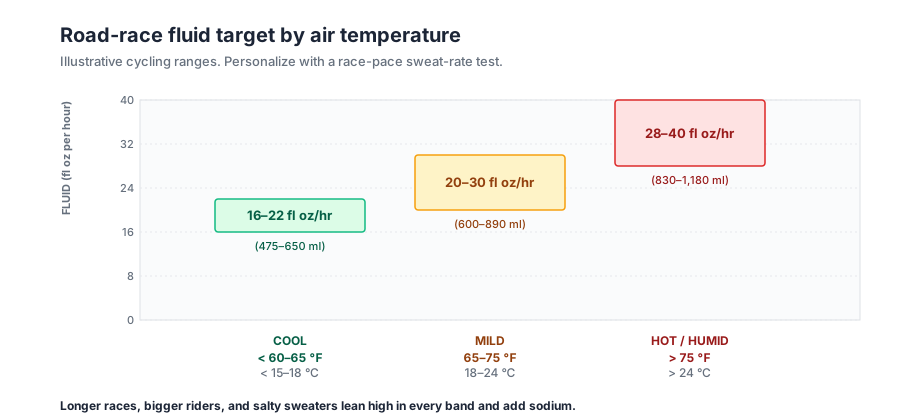
Three temperature rules to memorize: Cool (<65 °F) → 16–22 fl oz/hr (one bottle can cover many short races); Mild (65–75 °F) → 20–30 fl oz/hr (roughly one bottle per hour); Hot / humid (>75 °F) → 28–40 fl oz/hr (often one bottle every 30–45 minutes). Set a reminder every 10–15 minutes and personalize from sweat-rate data.
| Conditions | Fluid/hour | Setup |
|---|---|---|
| Under 60–65 °F (15–18 °C) | 16–22 oz (475–650 ml) | One 22–24 oz bottle can cover many criteriums or short road races |
| 65–75 °F (18–24 °C) | 20–30 oz (600–890 ml) | Plan about one bottle per hour; start with two if race time exceeds 90 minutes |
| >75 °F (24 °C) or humid | 28–40 oz (830–1,180 ml) | Start with two bottles and plan a fresh bottle every 30–45 minutes when support exists |
- Intensity matters: Road races surge. A race with the same average power as training can still demand more fluid because there are fewer calm drinking windows.
- Body size + sweat profile: Smaller riders often need a bit less; larger or salty sweaters need more. White salt streaks = consider a higher-sodium bottle.
- Course support: If feeds are frequent and reliable, you can carry less. If support is sparse, crowded, or late, start with more capacity.
- Test in race simulations: Weigh yourself pre/post (nude/dry). More than ~2% body mass loss suggests increasing intake; weight gain suggests backing off. You can use the sweat rate calculator for more precise tracking.
- Don't overdrink: Sip consistently. Clear, frequent urination mid-race or sloshing = too much. Pair fluids with sodium, especially in heat.
Scenarios: choose your bottle count
Use these quick scenarios to decide how many bottles to carry for US cycling road races. Adjust for your category, race speed, feed rules, sweat rate, and weather.
| Race format | Cool (≤55–65 °F) | Mild (56–75 °F) | Hot / humid (>75 °F) |
|---|---|---|---|
| Short criterium (20–35 min) | 0 bottles if well hydrated | 0–1 bottle | 1 bottle, mostly sodium/fluid |
| Standard criterium (40–75 min) | 1 bottle | 1 bottle | 1–2 bottles if cages/feed allow |
| Short road race (60–90 min) | 1 bottle | 1–2 bottles | 2 bottles |
| Standard road race (1.5–3 h) | 2 bottles | 2 bottles + optional handup | 2 bottles + planned handup/refill |
| Long road race (3–5 h+) | 2 bottles + feed-zone reset | Fresh bottle every 45–60 min | Fresh bottle every 30–45 min |
Detailed scenarios and setup notes:
Short criterium (20–35 min)
- Cool to mild: 0 bottles can work if you are fully hydrated and the race is truly short.
- Warm/humid or heavy sweater: 1 bottle at staging is safer; even a few sips before and during the race can prevent a dry mouth and late fade.
Standard criterium (40–75 min)
- Cool: 1 bottle is enough for most riders.
- Mild: 1 bottle with sodium and 20–40 g carbohydrate works well for many.
- Hot/humid: 1 bottle may still be enough, but start topped up and consider a second bottle if race length, cages, and rules allow.
Short road race (60–90 min)
- Cool: 1 bottle can be enough if you drink before the start.
- Mild: 1–2 bottles depending on intensity and how late the decisive climb or attacks arrive.
- Hot/humid: 2 bottles. One can be carb/sodium, the other lighter or plainer.
Standard road race (1.5–3 hours)
- Cool: 2 bottles at the start usually covers the race or gets you close.
- Mild: 2 bottles plus an optional feed-zone or team handup if the race is closer to three hours.
- Hot/humid: 2 bottles at the start and a planned mid-race bottle. Do not wait until both cages are empty before solving the next hour.
Long road race (3–5+ hours)
- Cool: 2 bottles at the start plus feed-zone resets.
- Mild: Plan a fresh bottle about every 45–60 minutes.
- Hot/humid: Plan a fresh bottle about every 30–45 minutes, with sodium in every hour and water available for dousing when legal.
Practical cues
- If you finish hard rides with salt crusts or lose more than 2% body mass, lean toward more fluid capacity.
- If feed support is reliable and you have practiced handups, you can carry less at any one time.
- If the course has long climbs, exposed wind, or no safe feed, start with more.
- Smaller riders often sit lower in the range; larger or sweatier riders often need two bottles sooner.
What to carry
- One bottle: short criteriums, cool short road races, or events with very early support.
- Two bottles: default for most road races over 60–90 minutes.
- Two bottles + handup/refill: default for hot races, races over two hours, and anything with a long feed gap.
For a tailored plan, use a bottle and gel planner to match your needs.
Always adjust for your own data, the race guide, and how your gut behaves at race intensity.
Race-day checklist: no-surprise hydration
- Confirm your plan: Target fluid rate (oz/hr), sodium (mg/hr), and bottle count based on forecast heat/humidity. Write it on your wrist or watch notes.
- Pre-load smartly: 2–3 hours pre-start, sip fluids regularly; last 15–20 minutes, take a few steady sips so you toe the line topped up — not sloshing.
- Label bottles: Mark each with time or segment targets (e.g., "0–45 min," "45–90 min") and sodium per bottle. Use contrasting tape and a bold marker.
- Calibrate sip size: Know how many sips = ~4 oz from your race bottle. Practice this so watch alerts translate to real intake.
- Feed-zone map: Note approximate mile markers, side of road, expected speed, and who is handing up. Decide when you will grab, skip, or request a bottle.
- Temperature adjustments: Plan +3–8 oz/hr and extra sodium for hot/humid conditions; scale back slightly if cool. Monitor sweat rate cues (salt crust, shirt weight, frequent thirst).
- Carry strategy: Choose bottle size and cage placement based on race length, road surface, and access while holding a steady line.
- Mix and backups: Pre-mix primary bottles. Stash sodium tabs or a single-use concentrate packet in case of spills or missed grabs.
- Watch cues: Set alerts every 10–15 minutes for sips; separate alert every 30–45 minutes for sodium if not in-bottle.
- Gut check: If sloshy, back off briefly; if your mouth feels tacky, power fades early, or cramps appear, increase fluids/sodium in small steps.
- Post-finish: Log actual intake vs. plan to refine for the next race. For a full checklist, see the race fueling checklist.
Plan it fast with a calculator
Skip guesswork. Use the cycling hydration calculator to turn temperature, duration, intensity, and sweat rate into a bottle plan for race day. Then use the race bottle and gel planner to connect bottles with gels, sodium, caffeine, and support.
Pro tip: Ride a 45–60 minute race-pace test in similar weather, weigh yourself before and after, track fluids and bathroom stops, and convert the change to sweat rate. That one number makes the calculator far more accurate.
If your race has a feed zone every 45–60 minutes, plan what you will start with and what you will grab. Hot and humid? Increase intake and sodium. Cool and dry? You may carry less. Practice your exact plan on group rides so bottle size, cages, and handoffs feel automatic.
Next steps: lock your plan and practice
- Fix your bottle count for race day. Decide now: one bottle, two bottles, or two plus support. Commit to exact volumes and what each carries: water, electrolytes, or carbs.
- Map your on-course refills. Check the official race guide for feed-zone spacing and handup rules, then mark which opportunities you will use or skip.
- Rehearse in race conditions. Do two race-like group rides with your full setup at target intensity and temperature. Practice drinking, replacing bottles, and taking handups without drifting.
- Calibrate hydration to weather. Warmer forecast? Add one extra support point or a higher-sodium mix. Cooler? Maintain frequency but reduce volume slightly.
- Finalize your checklist: bottle count, labeling, mix recipes, carry method, and refill plan. Then stick to it to avoid last-minute changes.
This content is educational and doesn't replace individualized medical, nutrition, or coaching guidance.
Image credits. Hero: Photo by wal_ 172619 on Pexels · Pexels License. Charts (sweat-rate math, fluid-by-temperature, aid-gap timeline, bike bottle placement): original FuelQ Pro illustrations · CC BY 4.0.
Frequently asked questions
How many bottles should I carry for a cycling road race?
For most US road races, start with one bottle for short criteriums or cool races under about 75 minutes, two bottles for 60–180 minute road races, and two bottles plus planned handups or refills for hot races or anything longer than about two hours.
Do I need two bottles if the race has a feed zone?
Usually yes for races over 90 minutes. Feed zones are easy to miss, and support may come later than your fluid schedule. Two bottles let you stay on plan before the first reliable handup.
Should one bottle be water and one be drink mix?
That is often a smart setup. Put carbohydrate and sodium in one bottle, then keep the other lighter or plainer so you can manage heat, chase gels, and avoid overly concentrated fluid when intensity is high.
How much should I drink per hour?
A practical road-race starting range is roughly 16–22 fl oz/hr in cool weather, 20–30 fl oz/hr in mild weather, and 28–40 fl oz/hr in hot or humid weather. Your measured sweat rate should personalize those ranges.
What about electrolytes and carbs?
Use sodium in every longer or hotter race, and count bottle carbohydrates toward your hourly carb target. A 6–8% carb solution is a comfortable starting point for many cyclists; stronger bottles can work but usually need plain water alongside them.
Hot or humid race day — carry more?
Yes. Start with two bottles when possible, plan a fresh bottle every 30–45 minutes if support exists, prioritize sodium-containing fluids, and take short sips every 10–15 minutes before thirst forces the issue.
What evidence-based sources support hydration and bottle-count planning?
ACSM's hydration position stand (Sawka et al., 2007) and the Exercise-Associated Hyponatremia consensus (Hew-Butler et al., 2015) outline individualized drinking and hyponatremia risk. IOC consensus statements on carbohydrate and sodium during exercise support matching fluids, carbs, and sodium to event demands. Always cross-check your race guide for feed-zone spacing and handup rules.
Turn this strategy into a real plan.
FuelQ Pro builds personalized fueling for your training weeks, long rides and races — plan, execute, review, improve.