Chronic Training Load (CTL) for Cyclists

Gabriel Ricce
Lamorinda MBO Racing · USA Cycling Coach Level 3
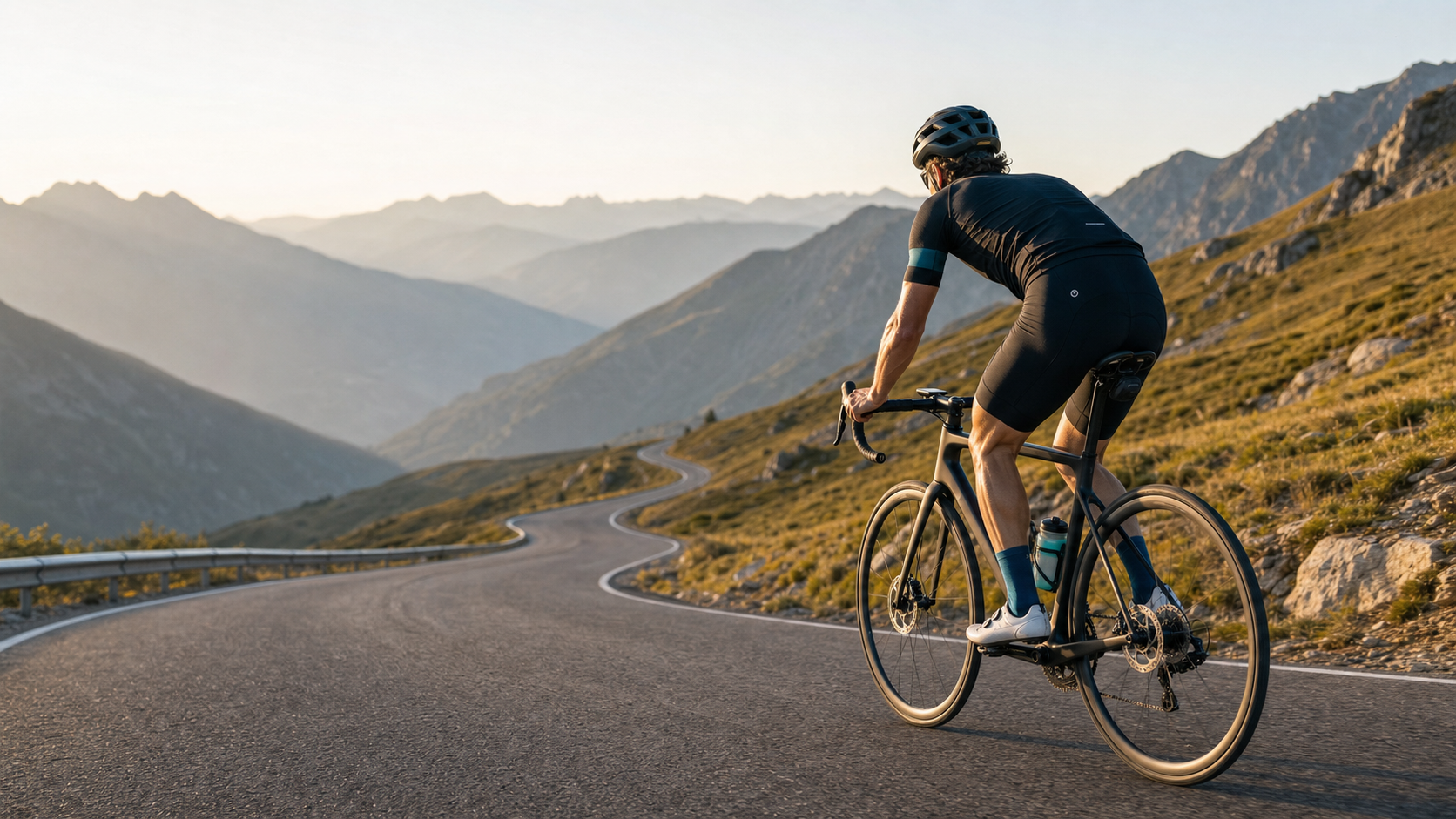
Chronic Training Load (CTL) is a rolling 42-day average of your daily Training Stress Score (TSS). It's a practical proxy for aerobic fitness — rising when you train consistently, falling with rest, and most useful when read alongside Acute Training Load (ATL) and Training Stress Balance (TSB).
What Is CTL and Why It Matters for Cyclists
Chronic Training Load (CTL) is a rolling measure of your long-term training volume and intensity, designed to estimate how much fitness you've built over time. In most cycling platforms, CTL is calculated from your daily Training Stress Score (TSS) using an exponentially weighted moving average over roughly 42 days. In plain terms: CTL rises when you consistently accumulate meaningful training stress and declines when you reduce load or take extended rest.
Why 42 days? It's a practical time horizon that balances responsiveness and stability. Short spikes from a single big workout won't dramatically move CTL, but steady training over several weeks will. That makes CTL a useful lens for planning blocks, benchmarking seasonal progress, and ensuring your fitness trajectory aligns with race goals. For a deeper dive into event preparation and how CTL fits into your planning, explore the race guides for cyclists.
What CTL is — and isn't. CTL is a proxy for aerobic fitness capacity, not a direct readout of performance on the day. Two riders with the same CTL can perform differently depending on freshness, fueling, sleep, heat adaptation, and race specificity. CTL doesn't account for skill, tactics, or how well your intervals map to target demands.
Why it matters for cyclists:
- Guides progression: A rising CTL typically reflects consistent training that supports higher workloads in future blocks.
- Informs readiness: Paired with short-term load (often called Acute Training Load) and balance metrics, CTL helps you decide when to push, maintain, or back off.
- Supports tapering: Strategic reductions in load before key events preserve most of your CTL-derived fitness while increasing freshness.
- Contextualizes off-seasons: A controlled CTL drop in transition periods helps you recover without losing the foundation for the next build.
Healthy ranges are individual. The "right" CTL depends on history, time availability, and event demands. Rapid CTL ramp rates can increase injury or burnout risk; conservative weekly increases are safer. Quality also matters: structured intensity and adequate recovery can raise performance at the same CTL compared to unstructured volume.
Bottom line: Use CTL to track long-term consistency and guide planning, but pair it with subjective feedback, recovery markers, and event-specific work to turn fitness into results.
Free: the Race Fueling Checklist
Turn this into a race-week plan: carbs, fluids, sodium, caffeine and aid-station prep in one free PDF you can print or keep on your phone.
How CTL Is Calculated
Chronic Training Load (CTL) quantifies your long-term training stress by averaging recent workload with an exponential decay that weights yesterday's work more than last month's. In practical terms, CTL represents your rolling fitness signal over roughly six weeks. It is calculated from daily Training Stress Score (TSS) or an equivalent workload metric, then smoothed with an exponentially weighted moving average (EWMA) so newer sessions influence CTL more than older ones.
At the daily level, you first need a consistent input: TSS from a power meter, heart-rate–based TSS (hrTSS), or pace-based TSS. Power-derived TSS is preferred for cyclists because it's anchored to functional threshold power (FTP), making load comparable across rides of different duration and intensity. Once each day's TSS is recorded, CTL updates by blending the new day with your existing CTL using a time constant that approximates six weeks (commonly 42 days).
Conceptually, the EWMA update can be thought of as: today's CTL equals yesterday's CTL plus a small fraction of the difference between today's TSS and yesterday's CTL. That fraction is determined by the time constant: the shorter the time constant, the faster CTL responds to recent training; the longer it is, the more inertia it has. With a 42-day constant, CTL changes gradually, filtering out day-to-day noise while capturing meaningful trends in training volume and intensity.
Because CTL is an average of stress, two riders can reach the same CTL with different training distributions. For example, a rider doing frequent moderate rides may arrive at a similar CTL as someone stacking fewer, higher-TSS sessions. The EWMA structure doesn't judge quality; it records quantity and intensity as expressed by TSS. That's why context — event goals, limiter work, recovery, and readiness — must accompany CTL when making decisions. For more on how fueling and nutrition interact with these metrics, see the fueling guide for cyclists.
It's also important to note that CTL assumes the TSS input is well-calibrated. If FTP is set too low, power-based TSS will be inflated and CTL will drift upward, suggesting more fitness than you truly have. Conversely, an overestimated FTP will suppress TSS and CTL. Regularly validate FTP and ensure consistent device data to keep CTL meaningful.
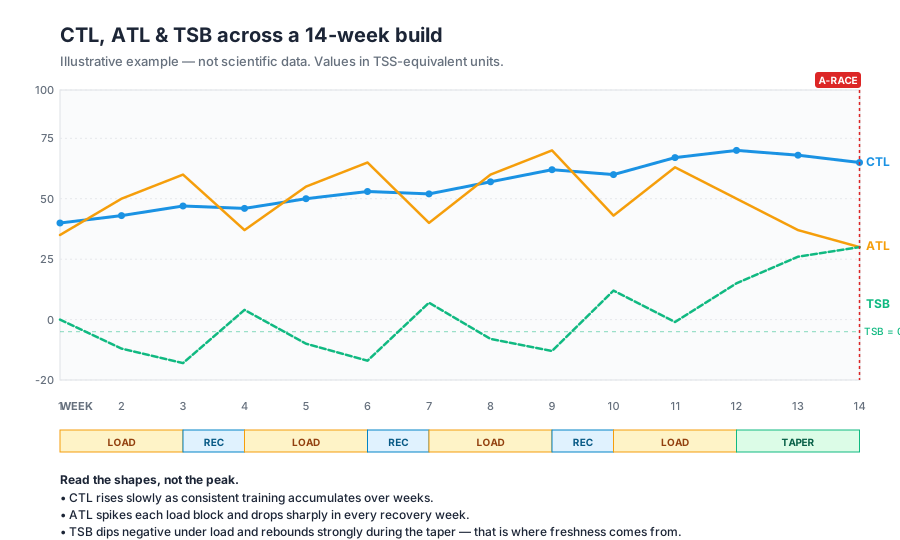
In most training platforms, you'll see CTL presented alongside Acute Training Load (ATL) and Training Stress Balance (TSB). ATL uses a much shorter time constant (about a week) to reflect short-term fatigue, while TSB is simply CTL minus ATL, a proxy for freshness. Together, these metrics help you monitor whether your training progression (rising CTL), your current fatigue (ATL), and your day-to-day freshness (TSB) are aligned with your plan.
Bottom line: CTL is the smoothed backbone of your workload history, built from daily TSS and a six-week weighting curve. Calculate it consistently, keep inputs accurate, and interpret it within the bigger picture of performance and recovery.
Get Your Thresholds Right (FTP/CP and Zones)
CTL only reflects reality if your training stress is calculated from accurate thresholds. For cyclists, that means getting your Functional Threshold Power (FTP) or Critical Power (CP) right and mapping them to appropriate training zones.
FTP vs CP. FTP is an estimate of the maximal power you can sustain for about an hour, commonly derived from shorter tests (e.g., 20-min test with a correction factor) or ramp tests. CP comes from a multi-point power–duration model that fits several maximal efforts (e.g., 3–5 min and 12–20+ min), yielding CP (your aerobic steady-state ceiling) and W′ (your finite work capacity above CP). FTP is simple and widely supported; CP can be more robust and responsive to your actual power–duration curve. Either works for CTL, but consistency in method and regular updates matter.
Testing options:
- 20-min time trial: Warm up thoroughly, ride 20 min all-out, multiply average power by ~0.95 to estimate FTP. Be aware of pacing and anaerobic bias.
- Ramp test: Increments every minute to failure; provides a quick FTP estimate but can misread athletes with atypical VO2max vs threshold profiles.
- CP field tests: Two to three maximal efforts on separate days (e.g., ~3–5 min and ~12–20 min). Use software to model CP and W′ from those points or your historical bests.
- Model from training data: With plentiful maximal efforts across durations, a power–duration model can refine FTP/CP without formal tests.
Updating frequency. Reassess every 4–8 weeks or after a clear performance shift (new PRs, training block completion, return from illness). Avoid frequent micro-adjustments that make CTL volatile; aim for stability with periodic recalibration.
Zones and TSS. Training Stress Score (TSS) for CTL typically uses Normalized Power and IF relative to FTP, whereas W′-bal/CP-based systems can use alternative load metrics. Whichever you choose, keep your zone schema consistent (e.g., 6–7 zone models) so workout intent and stress are comparable over time. If FTP/CP is set too high, you'll undercount stress (CTL lags reality); set too low and you'll overcount (CTL inflates, masking fatigue risk).
Practical tips:
- Validate threshold in workouts: Sweet spot and threshold sessions should feel hard but sustainable, not maximal. Repeated failures or effortless success are red flags.
- Use indoor/outdoor checks: Temperature, altitude, and terrain can shift effective threshold. If you train in mixed environments, consider separate profiles.
- Document changes: Note date and method of each update so you can interpret CTL trends around threshold adjustments.
For a more complete approach, pair accurate thresholds with nutrition fundamentals for cyclists to optimize both training stress and recovery. Get thresholds right first, then let CTL track the honest load you're applying.
Interpreting CTL Trends
Chronic Training Load (CTL) is most useful when you read the trend, not the single number. Think of CTL as a moving picture of your aerobic load over weeks. Rising CTL generally reflects accumulating training volume and/or intensity; falling CTL reflects reduced load and recovery. Flat CTL suggests maintenance. The key is context: what phase you're in, how fast CTL is changing (ramp rate), and how it aligns with performance markers and fatigue.
Rising CTL. A steady climb indicates successful load accumulation. For most cyclists, sustainable progress comes from moderate weekly increases rather than spikes. If CTL climbs while you feel generally fresh, sleep well, and hit quality targets, you're likely adapting. Combine the trend with subjective readiness and objective signals (e.g., stable heart rate response, consistent power at given RPE) to confirm you're on track.
Falling CTL. A controlled drop is expected during recovery weeks and taper. The intent is to shed fatigue while preserving fitness. If performance feels sharper, you're timing the reduction well. Prolonged declines without a purpose, or paired with flat/declining power and low motivation, may signal undertraining or excessive life stress — consider reintroducing structured work once you've stabilized.
Flat CTL. A plateau can be intentional in maintenance phases or a sign that training lacks a progressive stimulus. If you're aiming to peak later, holding CTL steady while increasing specificity (e.g., race-pace efforts) can be effective. If you want continued fitness gains, introduce small progressions in volume, intensity density, or frequency.
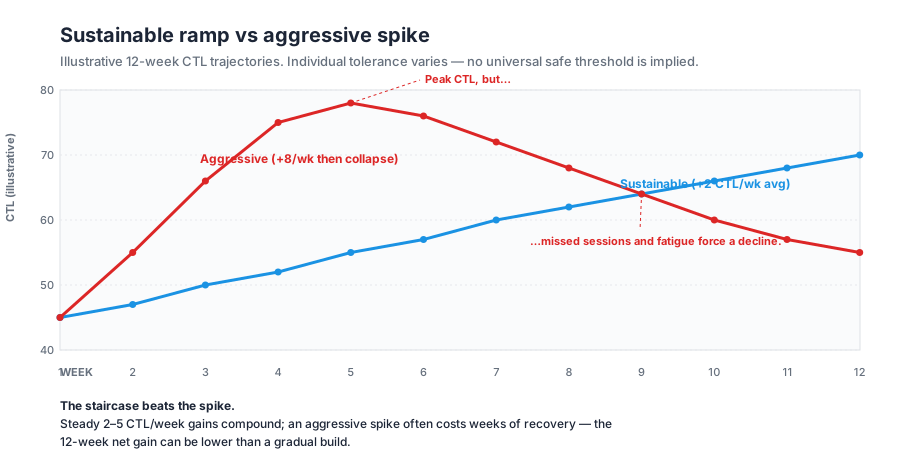
Ramp rate. How quickly CTL changes matters more than the absolute jump. Rapid increases can outpace your ability to recover, elevating injury/illness risk and degrading quality. Gradual ramps support durable adaptations. When you see a sharp uptick, cross-check acute strain (short-term load) and how you feel day-to-day; if sleep, mood, and output slip, back off slightly.
Event prep. Heading toward an A-race, you'll often target a peak CTL range that you personally tolerate well, then taper to reduce fatigue while maintaining most of that fitness. During taper, expect CTL to decline; the goal is improved freshness and stable performance in key tune-up sessions. Don't chase last-minute CTL gains at the expense of recovery. For fueling alignment during taper and race prep, refer to the fueling guide for cyclists.
Discipline and season context. CTL interpretation differs by event demands. Time trialists may keep CTL steadier with focused threshold work; gravel and ultra riders often sustain higher CTL from longer endurance sessions. In the off-season, a modest CTL dip alongside strength and technique work is normal; in base, a gentle rise is typical; in build, CTL may rise more slowly as intensity increases and recovery needs grow.
Individualization. Two riders with the same CTL can respond differently. Use CTL alongside Training Stress Balance (freshness), power–duration curve changes, and subjective measures. If CTL is rising but your best 20–60-minute power stalls, adjust intensity distribution or recovery. If CTL is flat yet performance improves, you may already be near an effective dose.
Red flags. Fast CTL spikes, persistent fatigue, declining quality in key sessions, poor sleep, irritability, or increased resting HR suggest maladaptation. When these coincide with a rising CTL, reduce load, prioritize recovery, and consider professional guidance.
Bottom line: Read CTL as a trend within your training phase, watch the rate of change, and corroborate with performance and readiness. Use it to steer progression and taper — not as a target to chase in isolation.
Using CTL to Plan Your Season and Peaks
Chronic Training Load (CTL) is most powerful when you use it to shape the arc of your season — building a resilient aerobic base, layering race-specific work, then arriving fresh and confident on key dates. Think of CTL as a compass for training load trends rather than a scoreboard. It helps you answer three questions: how much training am I absorbing, how fast can I increase it, and when should I stop pushing and sharpen for performance.
Start with anchor points. Identify A-races (true peaks), B-races (dress rehearsals), and C-races (training events). Work backward 12–20 weeks from an A-race to outline your macrocycle. The farther the race, the gentler the early slope of CTL should be; the closer the race, the more you protect freshness. For practical guidance on planning fueling and taper, check out the race guides for cyclists.
Plan progressive CTL ramps. Many cyclists tolerate a weekly CTL rise in the range of 3–8 points during general preparation, with smaller ramps (2–5) as intensity increases. Aim for staircase progressions — two or three loading weeks followed by a lighter week that allows CTL to consolidate instead of free-fall. If a rest week drops CTL slightly, that's normal; protect recovery to keep ATL under control and TSB from getting chronically negative.
Set a personal CTL peak band, not a single magic number. Historical data is your best guide: review seasons when you felt durable and fast, and note the CTL range 10–21 days before your best rides. Use that as your target band for the current season. If you lack history, build conservatively, track response, and refine. Remember that equal CTL can feel very different depending on training composition — high-intensity blocks with the same CTL are usually more taxing than aerobic volume.
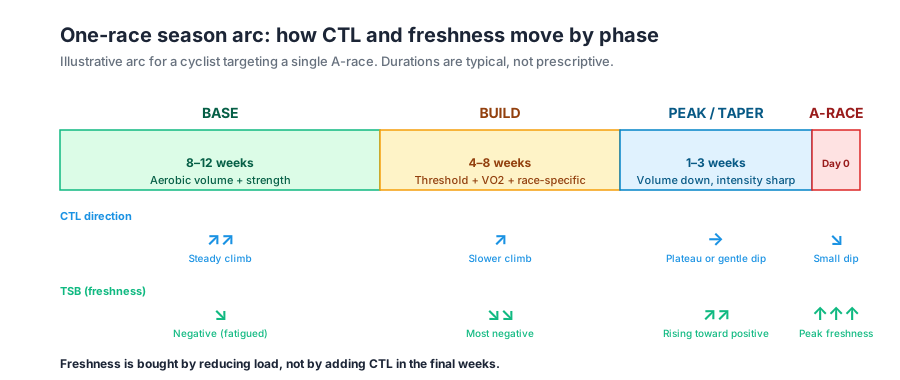
Sequence the season around phases:
- Base (8–12 weeks): Nudge CTL upward steadily with aerobic volume, low-to-moderate intensity, and strength work. Keep weekly CTL gains moderate and sustainable.
- Build (4–8 weeks): Maintain a smaller CTL ramp while increasing race-specific intensity. Expect ATL volatility; use recovery weeks to prevent overreaching.
- Peak/Taper (1–3 weeks): Allow CTL to stabilize or dip slightly while you reduce volume and keep a touch of intensity. The goal is improved freshness, not chasing a last-minute CTL bump.
Tapering with CTL is about direction and timing. Plan the final meaningful CTL high point roughly 10–21 days before your A-race. From there, trim volume 20–50% while retaining short, high-quality efforts. CTL will drift down; that is expected. Monitor TSB rising toward neutral or slightly positive as a sign that you're absorbing training. If you hold CTL too high into race week, you may arrive tired despite impressive charts.
Use mini-peaks for B-races. Schedule brief plateaus where CTL levels off for 7–10 days, paired with a mild freshness bump. These checkpoints validate pacing, fueling, and equipment under competitive stress without derailing the arc toward your A-race. For fueling specifics during these periods, the fueling guide for cyclists is a helpful resource.
Account for constraints and signals. Travel, illness, and work stress reduce capacity; flatten or pause CTL ramps accordingly. If resting metrics, mood, or power-to-HR trends sour, shorten the loading block. Similarly, if you adapt well, you can extend a block by a week — but keep the weekly CTL slope inside your personal tolerance window.
Common pitfalls:
- Chasing a CTL PR instead of relevance to the event's demands.
- Letting CTL free-fall in recovery weeks; reduce, don't vanish, your training stimulus.
- Ramping fast on intensity and volume simultaneously; adjust only one lever at a time.
Finally, match CTL to specificity. For long gran fondos, emphasize steady endurance to build CTL with lower intensity. For short, punchy road races, let CTL rise more modestly while you invest in anaerobic and VO2 work. CTL guides the load; specificity shapes the edge. Done well, you'll crest your season with enough fitness in the bank and freshness to spend it on the day that matters most.
CTL Isn't Everything: Balancing Load and Specificity
Chronic Training Load (CTL) is a powerful proxy for how much work your body has adapted to handle, but it doesn't describe what that work actually was. Two cyclists can share the same CTL and be prepared for entirely different demands. That's why CTL should guide, not dictate, your programming.
Specificity is the first check. Ask: does your training stress match the demands of your target event? A time trialist with long, steady threshold intervals needs a different mix than a climber preparing for repeated VO2max surges or a gravel racer facing variable terrain and fueling challenges. You can maintain or even raise CTL with lots of endurance riding, yet underperform if you've neglected the exact intensity distribution, cadence demands, terrain, or positioning practice your race requires. For more on how fueling influences this, see the fueling guide for cyclists.
Intensity distribution matters. If your CTL rise comes mostly from low-intensity volume, you'll build durability but might lack high-end power and repeatability. Conversely, stacking too much high-intensity work can inflate fatigue and impair adaptation, even if CTL looks healthy. Pair CTL with complementary signals — e.g., time in zone, critical power/FTP trends, repeatability of key intervals, and heart rate response — to confirm your load is moving the right capabilities.
Quality and density count. CTL averages stress over weeks, but it can't tell you whether key sessions are placed where you can actually absorb them. Two athletes with the same CTL can differ in session hit rate, execution quality, and recovery timing. Track the success of cornerstone workouts (e.g., 3x12–20 min at threshold; 5x3–5 min at VO2max) and the freshness markers that predict hitting them — sleep, HRV trends, resting HR, and subjective readiness.
Progression, not just accumulation. Use CTL to ensure you're building sustainable capacity, then layer progressive overload in race-relevant sessions: add reps, extend intervals, increase target watts slightly, shorten recoveries, or move efforts onto race-like terrain. Periodize: allow CTL to climb through a build, stabilize before the peak, and accept that a short taper may dip CTL while sharpening performance-specific metrics (e.g., improved power at race cadence, better fueling execution, lower HR drift).
Contextualize with constraints. Life stress, travel, heat, altitude, and nutrition can shift how a given CTL feels. Hydration and fueling strategies can turn the same TSS into either productive adaptation or excessive strain. Monitor how your perceived exertion tracks with familiar workloads; rising RPE at a stable CTL can flag accumulating non-training stress. For a practical nutrition approach, see nutrition fundamentals for cyclists.
Bottom line: aim for alignment. Let CTL anchor your view of chronic load, but measure success by event-specific benchmarks, key workout execution, and readiness signals. The right CTL is the one that supports the exact fitness you need on race day.
Heat, Altitude, and Environmental Factors
Same power ≠ same strain. Two 60-minute rides at 220 W can produce very different internal loads once you add 35 °C heat, 2,500 m of altitude, or a heavy travel week. CTL only reflects mechanical stress via TSS — it does not measure heat load, hypoxia, or life stress. Read the number in the environment it was earned in.
Environmental stressors change the physiological cost of your training, which can distort CTL if you read it without context. CTL aggregates Training Stress Score (TSS) over time; when heat or altitude raises heart rate, core temperature, or perceived exertion for the same mechanical output, you often accrue equal or lower TSS despite higher internal load — or, conversely, push higher intensity to hit familiar power and overshoot strain. The takeaway: CTL reflects load on paper, but environment can shift the true load your body experiences.
Heat. In hot or humid conditions, cardiovascular drift and dehydration increase physiological strain at any given power. Early in heat exposure, maintain power targets but accept higher heart rate and RPE; or, reduce target power 2–10% depending on severity and your heat acclimation status. Prioritize cooling and hydration (start rides euhydrated, sip consistently, add electrolytes on longer sessions). Track decoupling (power vs. heart rate) to spot accumulating heat strain. As you acclimate (typically over 7–14 days of controlled exposure), HR at a given power will normalize — allow intensity to rise gradually and let CTL rebuild rather than forcing it. For more on hydration and fueling, see nutrition fundamentals for cyclists.
Altitude. Hypoxia reduces available oxygen and lifts HR and ventilation at a given workload. On arrival (first 3–7 days, or longer at higher elevations), drop intensity and duration modestly (often 5–15%) and emphasize aerobic endurance and technique. Use heart rate and RPE to gate efforts; you may need to accept lower power for the same internal load. Sleep and hydration become bigger determinants of recovery; monitor HRV and resting HR to judge readiness before resuming threshold or VO2 work. Over weeks, partial acclimatization allows a careful return to target intensities; adjust zones using local field testing if you'll be at altitude for an extended block.
Wind, cold, and air quality. Strong headwinds inflate mechanical load; plan out-and-backs and pace by power, not speed. Cold can suppress HR and increase metabolic cost — extend warm-ups and layer to reduce stress mismatch. Poor air quality warrants reduced intensity or indoor training.
Practical CTL guidance. Annotate heat waves, altitude blocks, and AQI issues in your training log. Compare CTL trends with HRV, resting HR, and subjective fatigue. If CTL stalls or drops during environmental stress but recovery metrics worsen, you're likely underestimating true load — scale back intensity and rebuild progressively.
Week-to-Week: Practical CTL Management
Think in weeks, but act with daily intent. CTL rises when your Training Stress Score (TSS) stays consistently above your current CTL and falls when it stays below. Because CTL is a rolling average, small, steady surpluses drive predictable progress; erratic swings create noise and fatigue. Plan your week so the sum of TSS supports your goal rate of change, then distribute load smartly across days.
Set a realistic ramp. Many athletes target a 3–7 CTL/week increase during base and 1–3 during build. Your personal ceiling depends on history, recovery, and life stress. If you're new to structured training or coming back from time off, stay at the low end. If sleep, fueling, or work stress are compromised, pause the ramp or maintain. For fueling tips that support consistent progress, visit the fueling guide for cyclists.
Map your microcycle. A common pattern is: Mon recovery/REST, Tue key intensity, Wed aerobic endurance, Thu intensity or tempo/sweet spot, Fri recovery, Sat long endurance (primary load), Sun aerobic endurance or tempo. Assign approximate TSS per day aligned to intention (e.g., Tue 80–110, Thu 80–110, Sat 120–180). Back into your weekly target: if you want +4 CTL and your current CTL is 60, aim for a weekly TSS that's modestly above your recent average while still recoverable.
Use anchors and caps. Anchor the week with the long ride (largest TSS) and one high-quality intensity day. Cap any single day to avoid blow-ups: as a guideline, keep most weekday rides <120 TSS and avoid stacking two very high-TSS days unless you're experienced and well-recovered. If a day runs hot (unexpectedly high TSS), trim the next day or swap in recovery.
Control intensity distribution. Let endurance do the volume lifting and intervals do the signaling. For polarized or pyramidal models, ensure the majority of minutes remain easy even in higher-TSS weeks. Don't chase CTL with extra intervals — add time at low intensity or extend warm-ups/cool-downs to top up TSS with low cost.
Respect freshness. Monitor how you feel, sleep, heart rate variability (if you track it), and power/HR decoupling in endurance rides. If signals trend negative, hold CTL steady for a week (maintenance) or schedule a deload (reduce weekly TSS by ~20–40% with mostly easy riding). Protect recovery days — true low TSS accelerates progress more than marginally adding fatigue.
Adjust on the fly. Missed session? Replace with a shorter endurance ride, not an intensity double. Unexpected time? Add 20–40 minutes easy, not extra VO2. Heat, altitude, or heavy life stress? Lower targets and add fluids/carbs to keep quality.
Bridge to racing. Eight to twelve weeks out, transition from steady CTL building to specificity: keep weekly TSS near maintenance while shifting composition toward race-relevant intensity and terrain. Two to three weeks out, allow CTL to plateau or gently decline while sharpening; rely on freshness and specificity, not last-minute CTL gains.
Review each weekend. Log actual vs planned TSS, how you felt late in the week, and which sessions drove fatigue. If you're routinely missing targets or feeling flat, reduce the ramp or reallocate load away from weekdays and into the long ride.
Turn CTL into a real training plan
Reading CTL charts is a start — the payoff is a plan that turns weekly TSS targets into rides, fueling, and recovery you can actually execute. FuelQ Pro takes your race calendar, fitness history, and life constraints and builds a personalized week-by-week execution plan around them.
Build a personalized race-day fueling plan →
Common CTL Mistakes and How to Avoid Them
- Chasing a higher number for its own sake. Many riders equate a bigger CTL with better fitness, pushing volume blindly. CTL reflects training load trend, not race readiness. Avoid by aligning CTL targets with event demands and your life stress. Use performance markers (power at LT1/LT2, threshold, repeatability) and subjective metrics (RPE, mood) to validate that rising load is productive.
- Ramp rate that outpaces recovery. Spiking ATL to "boost CTL" often leads to fatigue and inconsistency. A typical sustainable CTL ramp is modest for most athletes. Avoid by planning gradual increases, inserting recovery weeks, and watching HRV, sleep, and mood. If you see power decouple from heart rate or RPE climbs at the same watts, hold load steady until you rebound.
- Ignoring training quality and specificity. Accumulating easy miles or random intervals can lift CTL while leaving critical abilities underdeveloped. Avoid by mapping sessions to limiters and event specificity: aerobic base, threshold, VO2, skills, and race-pace work. Quality trumps a small CTL bump when key sessions hit their targets. For more on aligning fueling and training quality, see the fueling guide for cyclists.
- Letting illness or life stress disappear into the score. CTL doesn't "see" non-training stress. Pushing through poor sleep, travel, or illness to protect a number invites setbacks. Avoid by reducing load or swapping intensity for easy spins when stress rises. Resume progression only when readiness markers normalize.
- Overusing group rides and races to inflate load. Frequent hard group days drive ATL spikes that may look productive but degrade adaptation. Avoid by capping unplanned intensity, protecting key workouts, and placing hard group rides where they support — not replace — structured work.
- Neglecting periodization and plateaus. Endless steady increases flatten adaptations. Avoid by cycling phases: build, overload, deload, and sharpening. Expect CTL to dip before peak events; freshness plus specificity beats a maximal CTL.
- Misinterpreting TSB/freshness signals. Relying only on TSB to decide readiness misses context. Avoid by combining TSB with how legs feel, recent workloads, and event needs. Track how you perform at given TSB ranges and use that personal data to guide taper targets.
- Comparing your CTL to others. Differences in physiology, data accuracy, and training history make cross-athlete comparisons misleading. Avoid by benchmarking against your own past seasons and outcomes.
Tools, Data Hygiene, and Simple Workflows
Tools
- Training platforms: Most cyclists track CTL via TrainingPeaks (PMC), WKO, GoldenCheetah, Intervals.icu, and Today's Plan. Each calculates CTL from daily Training Stress Score (TSS) or an equivalent (e.g., BikeScore) using an exponentially weighted moving average over ~42 days.
- Head units and apps: Garmin, Wahoo, Hammerhead, and many smart trainers estimate ride stress if FTP is set; sync these to your analysis platform to centralize CTL.
- Testing: Use ramp, 20-minute, or critical-power tests to anchor FTP/CP. Accurate intensity anchors are the foundation of valid TSS and, by extension, CTL. For a checklist to streamline your pre-race workflow, see the race guides for cyclists.
Data hygiene
- One source of truth: Pick a primary platform to compute CTL and disable duplicate uploads (e.g., don't sync both Garmin and Strava into the same account).
- Calibrate power: Zero-offset your power meter before key rides; match crank length; maintain firmware. If you switch devices, do a short validation ride to compare readings.
- Consistent FTP/CP: Update after meaningful changes (tests, big breakthroughs, or when workouts feel systematically too easy/hard). Avoid frequent micro-tweaks that create artificial CTL drift.
- Indoor vs outdoor: Smart trainers may read slightly higher/lower than your outdoor meter. If the offset is stable, keep it consistent; if it's large, consider device-specific profiles or a single meter across bikes.
- Duration integrity: Trim rides that include long pauses or car transfers. Remove accidental commutes recorded twice. Errant spikes or dropouts should be smoothed or excluded.
- Heart rate fallback: When power is missing, some tools estimate stress from HR. Use cautiously and flag those days; don't let a few noisy HR-only rides skew multi-week CTL trends.
Simple workflows
- Weekly rhythm: Plan your week, execute, then review on the same day each week. In review, check: (1) CTL trend (up, stable, or down), (2) last 7–10 days' workload vs plan, (3) upcoming training versus target CTL trajectory.
- Block planning: For a 3–5 week build, model daily TSS targets that raise CTL gradually (e.g., +3–6 CTL/week for experienced riders; less for newer riders). Insert recovery weeks where CTL plateaus or slightly dips while fatigue clears.
- Pre-race taper: Reduce TSS 30–50% over 7–14 days depending on race priority, holding some intensity. Expect CTL to drift down modestly while freshness improves.
- Alert rules: Create simple triggers — e.g., if your planned daily TSS is missed by >25% for three days, re-forecast the week rather than forcing catch-up.
- Notes and tags: Add context (illness, travel, heat) to explain anomalies. Future you will trust the CTL curve more when nuance is recorded.
Quality in, quality out: CTL is only as meaningful as your inputs. Prioritize reliable power, coherent syncing, and regular reviews, and CTL becomes a stable guide rather than a target to chase.
FAQs: CTL for Cyclists
What is CTL in simple terms? Chronic Training Load (CTL) is a rolling estimate of your long-term training stress. It reflects how much training your body has adapted to over the past several weeks, typically modeled as an exponentially weighted average of daily Training Stress Scores (TSS). Higher CTL generally indicates greater aerobic preparedness, not guaranteed performance.
How is CTL calculated? Most platforms use an exponentially weighted moving average of daily TSS with a time constant around 42 days (the "fitness" time constant). Recent training influences CTL more than older sessions. You don't calculate it by hand — your training software does — but understanding the 6-week sensitivity helps you plan ramps and recoveries.
What's a good CTL for cyclists? There is no universal "good" CTL. Appropriate ranges depend on discipline, history, and time available. A time-crunched rider might sit comfortably at 40–60 CTL, while experienced racers may sustain higher values. Focus on trends and how you feel and perform, not a specific number.
How fast should I increase CTL? A common guideline is to progress gradually, watching how you respond. Many coaches monitor weekly TSS increases alongside subjective metrics (sleep, soreness, mood) rather than chasing a fixed ramp rate. If fatigue, performance decline, or niggles appear, hold steady or reduce load.
Does CTL measure fitness? It's a proxy for training load, not a direct measure of performance. Pair CTL with objective markers (power at lactate threshold, repeatability, heart-rate decoupling) and subjective readiness. Two riders with the same CTL can perform very differently based on intensity distribution, durability, and freshness. For more on fueling and readiness, see nutrition fundamentals for cyclists.
How does CTL relate to ATL and TSB? ATL (Acute Training Load) tracks short-term fatigue (often ~7 days). CTL captures longer-term load (~42 days). TSB (Training Stress Balance) is the difference (CTL − ATL), often used to gauge freshness. Negative TSB suggests higher fatigue; positive TSB suggests more freshness. These are models; use them with context.
Should I include strength training in CTL? Traditional TSS comes from bike sessions with power or heart rate. Some athletes assign estimated TSS to strength or cross-training for a fuller picture, but estimates vary. Keep your approach consistent so your trends remain meaningful.
Why did my CTL drop during a taper? That's expected. Reducing load lowers ATL quickly and CTL gradually, allowing freshness to rise ahead of key events. Short-term CTL dips rarely harm performance and often improve it on race day.
Can CTL plateau? Yes. As your training stabilizes, CTL levels off. Plateaus aren't bad; they can signal a sustainable level. To advance, adjust volume, intensity distribution, or add focused blocks — balanced with recovery.
Is a higher CTL always better? No. Pushing CTL without quality, recovery, and health can backfire. Seek the minimum effective dose for your goals and life constraints.
How should beginners use CTL? Start by tracking consistency. Keep increases modest, emphasize technique and aerobic base, and validate progress with simple benchmarks (endurance ride power/HR, repeatability). Consult a qualified coach or healthcare professional for personalized guidance.
Related Reading and Next Steps
If you're ready to apply CTL intelligently, deepen your toolkit with these reads:
- Training Stress Score (TSS) fundamentals: Understand how TSS rolls up daily load into CTL, and how intensity factor (IF) and normalized power (NP) shape stress.
- Acute Training Load (ATL) and Training Stress Balance (TSB): Learn how short-term fatigue (ATL) interacts with CTL to inform freshness and race readiness.
- Periodization for cyclists: Map CTL targets to base, build, and peak phases so training stress serves your race calendar.
This content is educational and doesn't replace individualized medical, nutrition, or coaching guidance.
Frequently asked questions
What is chronic training load (CTL) in simple terms?
Chronic Training Load (CTL) is a rolling ~42-day exponentially weighted average of your daily Training Stress Score (TSS). It's a proxy for aerobic preparedness — rising with consistent training, falling with rest — not a direct performance predictor.
How is CTL calculated?
Most training platforms use an exponentially weighted moving average of daily TSS with a ~42-day time constant. Recent sessions influence CTL more than older ones. Software calculates it automatically once your rides sync with a valid FTP or CP.
What is a good CTL for cyclists?
There is no universal good CTL. A time-crunched rider may sit at 40–60 CTL; experienced racers can sustain higher values. Focus on the trend and on how you feel and perform, not a target number.
How fast should I increase CTL?
Progress gradually. Many cyclists tolerate 3–7 CTL points per week in base and 1–3 in build. Watch sleep, HRV, mood, and workout quality; hold or reduce load if fatigue accumulates.
Does CTL measure fitness?
CTL is a proxy for training load, not a direct measure of performance. Pair it with objective markers (power at threshold, repeatability, HR decoupling) and subjective readiness before drawing conclusions.
How do CTL, ATL, and TSB relate?
ATL (Acute Training Load) tracks short-term fatigue over ~7 days. CTL captures long-term load over ~42 days. TSB (Training Stress Balance) is CTL minus ATL, a proxy for freshness — negative means fatigued, positive means fresh.
Why did my CTL drop during a taper?
That's expected. Reducing load lowers ATL quickly and CTL gradually, letting freshness rise ahead of a key event. A short-term CTL dip rarely hurts race-day performance and often improves it.
Turn this strategy into a real plan.
FuelQ Pro builds personalized fueling for your training weeks, long sessions and races — plan, execute, review, improve.