AI Sports Coach: How Cycling Coaches Use AI

Gabriel Ricce
Lamorinda MBO Racing · USA Cycling Coach Level 3
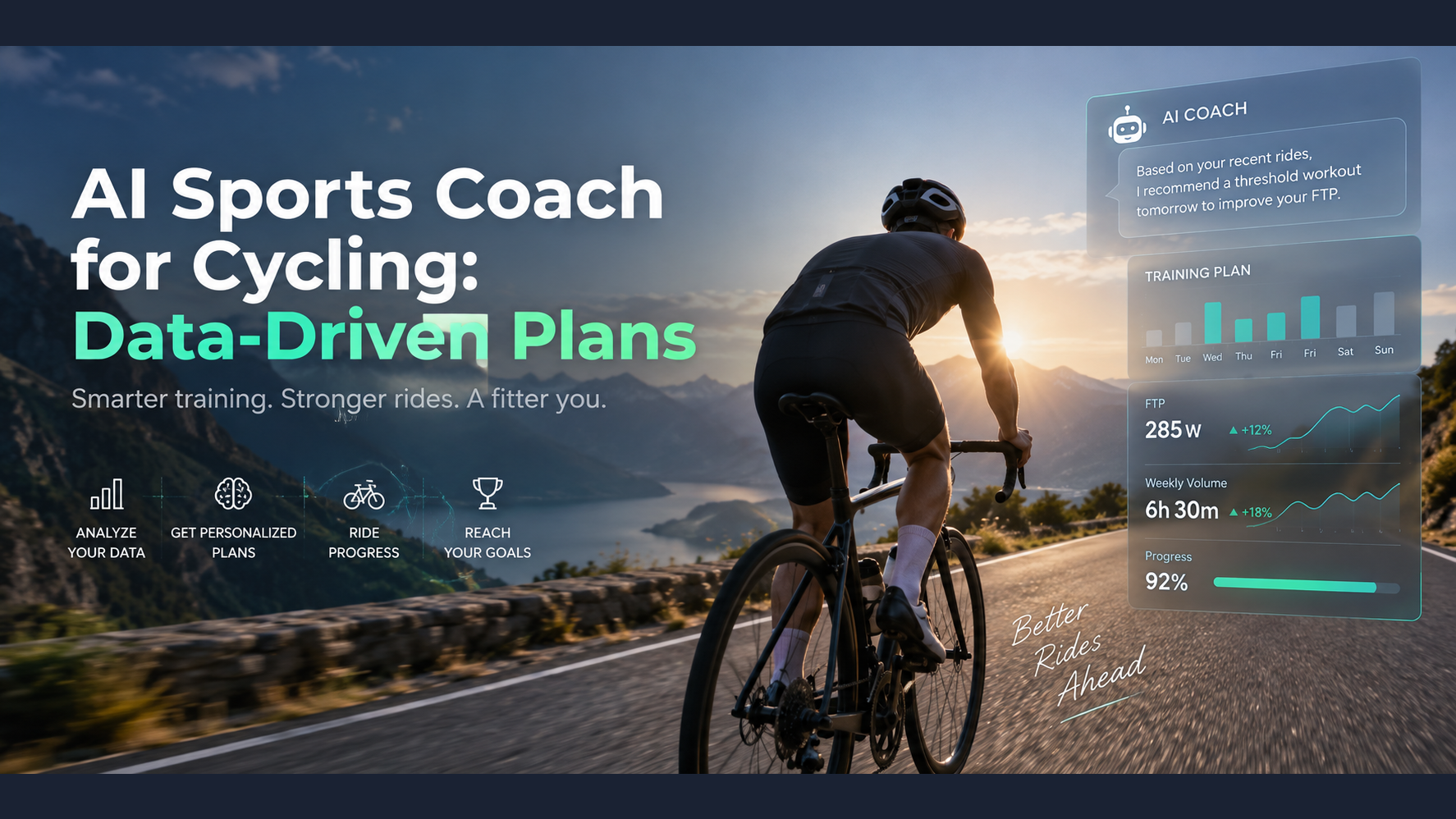
An AI sports coach is software that analyzes an athlete's data (power, heart rate, HRV, sleep, weather, fueling logs) and turns it into suggestions for training, recovery, and nutrition. Used well, it does not replace a human coach. It takes over the hours of file analysis, so the coach can spend that time on judgment, context, and the athlete's needs. The result is a more precise prescription that is adjusted more often, and the coach still makes every call.
AI Doesn't Coach. Coaches Coach.
A coach with 20 athletes cannot read every file line by line. Most coaches triage: they look closely at key sessions, skim the rest, and adjust the plan weekly. Small signals slip through, like heart rate creeping up at steady power, an athlete who fades in the last interval every Thursday, or a long ride done on half the planned carbs.
AI is good at exactly that kind of work. It reads every file, every day, and doesn't get tired. It does not know that the athlete just changed jobs, is afraid of descending in the rain, or needs a confidence-building session more than a hard one. The coach knows those things.
So the question to ask is what AI should handle, so that the coach can do more of the work only a coach can do.
Free: the Race Fueling Checklist
Turn this into a race-week plan: carbs, fluids, sodium, caffeine and aid-station prep in one free PDF you can print or keep on your phone.
Where AI Helps a Coach, and Where the Coach Decides
| Coaching task | What AI contributes | What the coach still decides |
|---|---|---|
| File review | Flags decoupling, fading intervals, missed targets across every ride | Which flags matter for this athlete right now |
| Load management | Tracks load trends and projects next week's options | How much risk to take, given life stress and the race calendar |
| Readiness | Combines HRV, resting HR, sleep, and RPE into a daily picture | Whether to push, swap, or rest, after talking to the athlete |
| Fueling | Calculates carb, fluid, and sodium ranges per session and per race | What the athlete can tolerate and carry, and will actually eat |
| Race prep | Segments the course, pulls the forecast, drafts pacing and fueling by sector | Tactics, contingency plans, and the final race-morning call |
| Communication | Summarizes the week in plain language | The conversation itself |
In each of these tasks the AI supplies analysis, and the coach supplies judgment.
More Precise Prescriptions, Adjusted More Often
Traditional planning works in weekly blocks because a human has limited review time. With AI doing the first pass on every file, a coach can adjust daily without working more hours.
In practice, that looks like this:
- Targets that track current fitness. Thresholds drift. AI spots the change from ride data weeks before the next formal test, and the coach confirms and updates the zones.
- Progression by energy system. If aerobic durability is improving but repeatability is lagging, the coach sees that split clearly and can shift the mix, rather than adding a flat percentage of load.
- Faster reaction to a bad week. Poor sleep, travel, and heat all show up in the data. AI proposes a reshuffled week, and the coach approves, edits, or overrides it.
The prescription gets more specific because the coach is working from a complete picture instead of a sample.
Reading Readiness: Signals and Responses
| Signal | What it may indicate | Typical coach response |
|---|---|---|
| HRV trending down over several days | Accumulated fatigue or outside stress | Reduce intensity, check in with the athlete |
| Resting HR elevated for 2–3 mornings | Under-recovery, heat, or oncoming illness | Swap intervals for easy endurance or rest |
| Higher RPE at usual power | Fatigue or under-fueling | Review recent fueling and sleep before changing load |
| HR rising at steady power late in rides | Dehydration, heat, or low carb intake | Review fluid and carb plan for long sessions |
| Stable HRV, normal RPE, good sleep | Ready for quality work | Proceed with the key session |
These are patterns to interpret. A single bad reading tells a coach little. AI surfaces the trend, and the coach reads it in context.
Fueling: The Prescription Most Coaches Don't Have Time to Write
Most training plans specify intervals to the watt, and fueling to "eat enough." The reason is time. A proper fueling prescription depends on duration, intensity, heat, humidity, sweat rate, and gut tolerance, and it changes for every session and every race.
This is where AI saves a coach the most work. It can calculate session-specific ranges in seconds, and the coach can then adapt them to the athlete.
| Ride type | Carbs per hour | Fluid per hour | Notes |
|---|---|---|---|
| Easy endurance, under 90 min | 0–40 g | To thirst | Fueling optional if well fed beforehand |
| Endurance, 2–4 h | 40–70 g | 400–750 ml | Start eating in the first 30 minutes |
| Hard training or racing, 2 h+ | 60–90 g | 500–1,000 ml | Requires practiced gut tolerance |
| Long racing, gut-trained athlete | 90–120 g | Based on measured sweat rate | Use mixed carb sources and rehearse in training |
These are commonly cited ranges. They are not individual prescriptions. Heat, body size, and tolerance shift them. Sodium needs vary widely between athletes and are best estimated from sweat testing or a measured sweat rate.
For the reasoning behind these numbers, see our guides on cycling fueling strategy, carbs per hour for cycling, and electrolytes for cycling. To measure instead of guessing, use the sweat rate calculator.
The coach's role here is practical. Coaches know which products the athlete tolerates, and how many bottles fit on the bike. They also know whether the plan was actually followed. AI can compare planned versus consumed after each ride, which turns fueling into something a coach can track and improve the same way they track power.
Race Prep: A Draft Plan the Coach Finishes
For a target event, AI can segment the course by gradient and surface and pull the forecast. From that it drafts pacing and fueling by sector, for example a carb target for each climb, or a note on where to drink before a technical descent.
That draft is a starting point. The coach adds what the model cannot see, like how the athlete handles pressure or how the race tends to unfold. The coach also plans for what happens if a bottle is dropped at kilometer 40. Our race guides show what event-specific fueling looks like for races like Leadville Trail 100, SBT GRVL, and Brasil Ride Paraíba. For long events, how to fuel long bike rides covers the fundamentals.
What AI Cannot Do
- It depends on data quality. A miscalibrated power meter or a missing HR strap produces confident, wrong suggestions.
- It doesn't know the person. Motivation, fear, family, work, and health history are not in the file.
- It is weakest in new conditions. First altitude camp, first heat race, return from illness. Predictions are least reliable exactly when the stakes are highest.
- It is not a clinician. Questions involving the menstrual cycle, medications (including GLP-1s), REDs risk, or persistent fatigue belong with a qualified healthcare professional. AI output here is educational at most.
A good AI tool shows its reasoning and its uncertainty. If it can't explain why it's suggesting something, the coach should treat the suggestion with caution.
Athlete Data and Consent
Coaches who use AI tools are handling sensitive data on someone else's behalf. Athletes should know what is collected and who can see it. They should also be able to disconnect a data source or export their records at any time. Tracking of sensitive information, such as cycle phase, should be opt-in.
A Simple Workflow for Coaches
- Connect the data. Power, heart rate, and ride files are the minimum. Sleep, HRV, and fueling logs sharpen the picture.
- Let AI do the first pass. Review flags and summaries, not raw files, for routine sessions.
- Keep your eyes on key sessions. Read those files yourself.
- Add fueling to every long or hard session. Treat it like an interval target: specific, written down, reviewed afterward.
- Talk to the athlete. Use the hours you saved on the conversation.
- Review weekly. Look at what the AI got right and what it missed, and note what you overrode and why.
Get a free race-day carb, fluid, and sodium estimate for your athlete's next event →
This content is educational and doesn't replace individualized medical, nutrition, or coaching guidance.
Frequently asked questions
What is an AI sports coach?
Software that analyzes training, recovery, and fueling data and suggests adjustments. It works best as a tool used by a human coach or a self-coached athlete. It does not replace coaching judgment.
Can AI replace a human cycling coach?
No. AI handles analysis and calculation at a scale no person can match. It cannot weigh life context, build trust, or make judgment calls under uncertainty. The strongest setup is a coach using AI.
How does AI make training prescriptions more precise?
It reviews every session, detects fitness and fatigue trends early, and proposes adjustments daily rather than weekly. The coach confirms or changes them.
Where does AI save coaches the most time?
Routine file review and fueling calculations. Both are data-heavy and repetitive, and both are easy to skip when a coach is busy.
What data does an athlete need?
A power meter and heart rate monitor give the strongest signal. Heart rate and RPE alone still work. Sleep, HRV, and fueling logs improve accuracy.
Is AI-generated fueling advice safe to follow?
Treat it as an educational starting range. Test it in training, adjust with your coach, and consult a sports dietitian or physician for medical or individual nutrition questions.
I don't have a coach. Is an AI sports coach still useful?
Yes, especially for fueling and hydration planning, where most self-coached riders are guessing. Be conservative with training-load suggestions, and get human input before big changes.
Turn this strategy into a real plan.
FuelQ Pro builds personalized fueling for your training weeks, long sessions and races — plan, execute, review, improve.