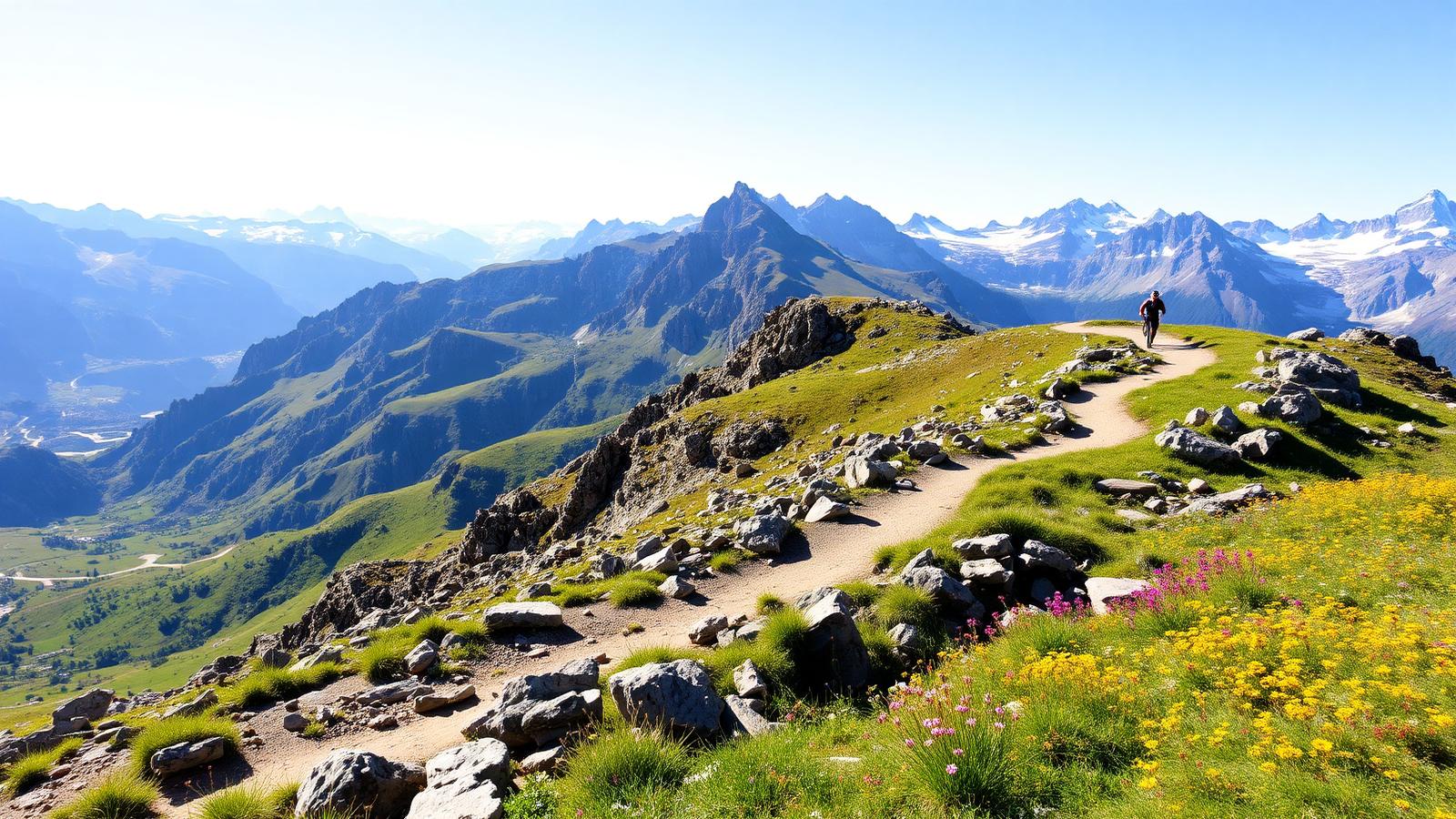
The Swiss Epic is a five-day pairs-format mountain bike stage race held every August in the Swiss Alps, part of the Epic Series (sister event to the Absa Cape Epic in South Africa). Recent editions have been based in the canton of Grisons, moving between host towns like Davos, Klosters, Lenzerheide and Arosa. Days spent above 6,560 ft on Alpine singletrack, four consecutive nights of recovery between stages, and the strict pairs-format rules (teammates must finish within 2 minutes of each other) make it one of the most respected — and hardest — amateur MTB stage races in Europe. Entry is capped, sells out early, and typically fields 200–300 teams.
Distance
≈ 186–249 mi total across 5 stages (year-to-year; typical single-stage 37–56 mi)
Elevation
≈ 12,000–45,930 ft cumulative climbing across the week
Typical duration
4 – 8 hours per stage for most amateur finishers; leaders sub-4 h
Location
Swiss Alps — canton of Grisons in recent editions (Davos / Lenzerheide / Klosters / Arosa host rotation)
Course details, host towns, aid station layouts, cutoff times and weather-based route modifications may change year to year. The organizer publishes the definitive current-year GPX and Athletes' Manual on epic-series.com/races/swissepic 4–6 weeks pre-race. Race-morning route decisions (weather closures) are communicated at daily briefings. Third-party route summaries and previous-year GPX should not be treated as the official current-year route.
Download the free printable race-day fueling checklist for Swiss Epic
A practical race-week checklist: carbs, hydration, sodium, caffeine and race-day supplies — print it or keep it on your phone.
Multiple stages cross passes above 8,200 ft, with several stage summits or finishes above 6,560 ft. Reduced oxygen availability slows carbohydrate absorption, blunts appetite and drops sustainable power 5–10 % versus sea level. Cumulative altitude exposure over 5 days compounds the effect.
Cumulative fatigue
Five consecutive stages compound glycogen debt, muscle damage, sleep deprivation and GI wear. By Day 3, most teams are managing rather than racing — recovery nutrition, sleep discipline and pacing decide the second half of the week.
Alpine weather variability
Swiss August weather can swing from 86 °F valley heat to sub-freezing rain, hail or snow on high passes within a single stage. Recent editions have had stages shortened or re-routed for weather. Layering and cold-weather fueling are not optional.
Technical singletrack
Long high-Alpine singletrack descents leave no bandwidth for eating. Some sections are genuinely technical (rocky, exposed, above tree line) and fueling must be front-loaded on climbs and rolling sections.
Pairs format constraints
Teammates must be within 2 minutes at all times and cross the finish line together. A single bonk, mechanical or crash affects both riders. Fueling coordination, aid-stop discipline and shared pace management are as important as fitness.
Race-village logistics
Stages start and finish in different mountain towns each day. Riders move between host venues via team-organized transfer or the race's shuttle service. Sleep, meals and bike prep happen in constantly changing lodging — plan the logistics before you commit to the race.
Cost and entry commitment
Team entry runs several thousand CHF and includes race village services (meals, mechanical support, timing). But partner selection is high-stakes: entering as a pair means committing to another rider's fitness, temperament and fueling discipline for a week under stress.
Course profile — segment by segment
A tactical breakdown of the Swiss Epic course. Use this to plan pacing, fueling touchpoints and where to conserve versus commit.
Segment
Mile
Elevation
Note
Stage 1 — settling in
Typically 70–90 km, 2,000–3,000 m of climbing
—
Ride conservatively — this is Day 1 of 5. Cap effort at high zone-2 HR for both riders. Rehearse aid-station handoffs and pairs-format discipline. Do NOT chase the leaders.Surface: Mix of fire road climbs and moderate singletrack
Stage 2 — first altitude test
Typically 60–80 km, 2,500–3,500 m of climbing
—
First high-altitude stage of the week. Drop carb intake by 10–20 g/hr above 8,200 ft. Force fluids on descents — dry air suppresses thirst. Confirm cumulative body mass loss <1 % before dinner.Surface: Sustained Alpine climbs, high-altitude passes, technical descents
Stage 3 — queen stage
Typically 80–100 km, 3,000–4,000 m of climbing
—
The defining stage. Pre-load with a bigger breakfast (top of 3–4 g/kg CHO range). Pack extra gels + one solid item. Pairs-format discipline is critical — no surge attempts. Ride to power, not to feel.Surface: Longest climbing day; usually the highest-altitude summit of the week
Stage 4 — recovery-active
Typically 60–75 km, 2,000–2,800 m of climbing
—
Manage cumulative fatigue. Legs feel worse than the numbers suggest by Day 4. Focus on hydration and steady pace — do not chase GC positions unless both riders are in fresh form.Surface: Shorter day, often more singletrack-heavy
Stage 5 — finale
Typically 65–85 km, 2,500–3,500 m of climbing
—
Emotional pacing is the risk. Trust the routine: alarm-based fueling, pairs discipline, ride to power, celebrate at the finish line — not at km 30. Save the biggest caffeine dose for this stage.Surface: Mix of climbs, technical descents, finish in the primary race village
Aid stations & crew strategy
Every aid station along the Swiss Epic course, with crew access, drop-bag rules and the fueling action to execute at each stop.
Typical Stage aid — early climb
Mile ≈ km 20–25 (varies by stage)
Quick bottle swap and one gel. < 90 seconds. Restart with your partner.
Typical Stage aid — mid-race
Mile ≈ km 35–50 (varies by stage)
Full bottle reset, one solid item, layer decision if weather is shifting. 2–4 minute stop max. Both riders eat before restarting.
Typical Stage aid — final quarter
Mile ≈ km 55–70 (varies by stage)
The last aid before the finish. Force one bottle + one gel even if you feel fine. This is where under-fueled teams lose the most time in the final hour.
Fueling challenges & strategy
General, evidence-based guidance. Numbers should always be personalized to sweat rate, body mass, fitness and weather.
Carbohydrate strategy per stage
60–90 g/hr of mixed-source (glucose + fructose) carbohydrate per stage for most amateur riders; trained guts can push to 90–110 g/hr on shorter stages. On the biggest climbing days at altitude, drop to 60–80 g/hr — pushing sea-level volumes above 8,200 ft triggers nausea.
Hydration
17–34 fl oz/hr baseline per stage, biased higher in dry Alpine air. Track daily body-mass at the same time each morning (weigh before breakfast) to catch cumulative dehydration. A 1 % daily deficit becomes a 4–5 % deficit by Day 5 if untreated.
Sodium
500–1,000 mg/L of fluid, tuned to sweat testing. Long Alpine days can outrun a cautious sodium plan — cumulative loss over 5 stages is the classic cause of late-week cramping and cognitive fog. Salt caps in a jersey pocket let you dose independently of drink-mix flavour fatigue.
Caffeine rotation
3–6 mg/kg per stage, split pre-start and mid-race. Rotate lower-dose days (Days 2 and 4) to preserve responsiveness for the queen stages. Skip caffeine entirely for one 24-hour window mid-week if the schedule allows — the response comes back sharper for the final stages.
Aid station strategy
Every stop is a bottle swap first, calorie top-up second. Pre-mix bottles the night before and label them by stage-hour. Epic Series aid stations typically stock water, sports drink, bananas, cola and basic snacks — bring your own gels and preferred products; do not trust brand availability to match your gut.
Pre-race breakfast (each morning)
1–4 g/kg carbohydrate 2–4 hours before each stage, from rehearsed low-fibre, low-fat foods. Rotate 2–3 breakfast options across 5 mornings to prevent flavour fatigue. Race village kitchens open early — confirm timing on Day 1.
During-race execution
Fuel by the clock, not by feel. Altitude, cold, technical singletrack and pairs-format concentration all suppress hunger cues. Set a 20-minute alarm on the head unit for every stage and log every intake to catch drift before it becomes deficit.
Recovery between stages
Within 60 minutes of every finish: 1.0–1.2 g/kg carbohydrate, 0.3 g/kg protein and 150 % fluid replacement with sodium. Dinner: 2–3 g/kg CHO. Bedtime snack: 30–50 g CHO if the day was long. Recovery on Day 1 shapes Day 5 — treat every finish as a full nutrition transaction, not a spectator moment.
Fueling timeline by phase
Grams and millilitres per hour for each phase of the race. Personalize to your sweat rate, body mass and conditions.
Swiss Epic · 5-stage arc for a mid-pack amateur team
Race-week arrival & pre-Stage 1 load (T-3 days)
Race village (Davos / Lenzerheide / etc.)·Arrival to Day 1 morning
Carbs
8–10 g/kg body mass/day carb load
Fluids
101–135 fl oz/day with sodium
Sodium
500–1,000 mg/L
Focus: Sleep priority, low-fibre carb load, familiar foods only. Recon Stage 1 finish area if possible. Rehearse aid-station handoffs with your partner on a short recon ride.
Stage 1 — settling in
Typically 43–56 mi, 2,000–9,840 ft of climbing·4–6 hours
Carbs
70–90 g/hr
Fluids
20–30 fl oz/hr
Sodium
600–900 mg/L
Caffeine: 100–200 mg pre-start, 100 mg mid-race
Focus: Ride conservatively. Do NOT chase the leaders. Aim for high zone-2 heart rate for both riders. Practise the pairs-format aid stop discipline — 2 minutes max, both riders eat, both restart together.
Stage 2 — first altitude stage (usually)
Typically 37–50 mi, 2,500–11,480 ft of climbing·4–7 hours
Carbs
60–80 g/hr (altitude-adjusted)
Fluids
24–34 fl oz/hr
Sodium
700–1,000 mg/L
Caffeine: 100 mg pre-start, low-dose day
Focus: First high-altitude stage. Drop carb intake above 8,200 ft by 10–20 g/hr. Force fluids on descents — dry Alpine air suppresses thirst. Confirm cumulative body mass loss <1 % before dinner.
Stage 3 — queen stage (usually)
Typically 50–62 mi, 3,000–13,120 ft of climbing·5–8 hours
Focus: The longest and hardest stage of the week. Pre-load with a bigger breakfast (top of range 3–4 g/kg CHO). Pack extra gels + one solid item in your jersey/pack. Pairs-format discipline is critical — no surge attempts here.
Stage 4 — recovery-active stage
Typically 37–47 mi, 2,000–9,190 ft of climbing·4–6 hours
Carbs
70–90 g/hr
Fluids
20–30 fl oz/hr
Sodium
600–900 mg/L
Caffeine: Rotation low-dose day (100 mg pre-start only)
Focus: Manage cumulative fatigue. Legs feel worse than the numbers suggest by Day 4. Focus on hydration and steady pace — do not chase overall positions here unless you and your partner are both in fresh form.
Stage 5 — finale
Typically 40–53 mi, 2,500–11,480 ft of climbing·4–7 hours
Carbs
70–90 g/hr
Fluids
24–34 fl oz/hr
Sodium
700–1,000 mg/L
Caffeine: 150–250 mg for the final stage — save the biggest dose here
Focus: The finish line stage. Emotional pacing is a real risk — riders over-cook the first hour to 'seal' a GC position. Trust the routine: alarm-based fueling, pairs discipline, ride to power, celebrate at the finish line, not at km 30.
Recovery (T+0 to T+72 h post-Stage 5)
Race village finish + travel home·First 72 h after crossing the final finish line
Carbs
1.0–1.2 g/kg within 60 min, then 8–10 g/kg over 24 h, tapering
Fluids
150 % of estimated body-mass loss with sodium
Sodium
3,000–5,000 mg cumulative day 1 post-race
Focus: Race-village pasta party + real Swiss meal (Rösti, Älplermagronen, Zopf). Sleep priority for 2–3 nights. Ferritin, vitamin D and iron check 7–10 days after, not immediately. Recovery week: easy spins only for 5–7 days.
Numbers assume a 5–7 hour daily amateur team in typical mid-August Grisons conditions (50–59 °F mornings, 68–82 °F valleys, 41–50 °F on 2,500+ m passes). Faster teams (4–5 hours/stage) can hold higher carb intake but must protect between-stage recovery. Slower teams (7+ hours/stage) should bias to more real food and shift caffeine timing later in each stage. Individual sweat rate can shift fluid and sodium targets by ±30 % — personalize with a pre-race sweat test in similar Alpine conditions.
Carbohydrate loading for Swiss Epic
A structured 48–72 hour carbohydrate-loading protocol tuned for a long day at altitude. Rehearse it before a training block, not for the first time on race week.
Full 48–72 h load into Stage 1
Target 8–10 g/kg body mass per day of carbohydrate from familiar low-fibre sources: rice, pasta, potato, bread, sports drinks, honey. A 154 lb rider aims for 560–700 g CHO/day. Reduce fat and fibre to protect the gut on Stage 1 morning.
Protein & fat
Keep protein moderate (1.2–1.6 g/kg/day). Reduce fat to ~0.5–0.8 g/kg/day. This is not the week for heavy Swiss meals (Rösti with butter, Raclette) — save those for the post-race dinner.
Hydration & sodium
Drink to pale-yellow urine, add 500–1,000 mg sodium per litre of fluid on the two days before Stage 1. Plasma volume expansion supports thermoregulation and altitude tolerance.
Between-stage top-up (each evening)
In the 60 min post-finish window: 1.0–1.2 g/kg CHO immediately. Dinner at the race village: 2–3 g/kg CHO from Swiss race-food (pasta, rice, potato, bread, sports drinks). Bedtime snack: 30–50 g CHO if you had a big fluid or glycogen deficit on the day. This routine matters more than the pre-race load — it's what sustains days 3–5.
Race-morning breakfast (each day)
1–4 g/kg CHO 2–4 hours before each stage start. Rotate 2–3 breakfast options across 5 mornings to prevent flavour fatigue. The race village kitchen opens early — confirm the daily start time and adjust breakfast timing accordingly. Same meal from Day 1 to Day 5 also works if it settles in your stomach.
Sub-9 & sub-12 split targets
Aid-station splits for the two headline finish goals at Swiss Epic: the Big Buckle (sub-9) and the Silver Buckle (sub-12). Use as planning anchors, not as commitments — weather, altitude adaptation and pack dynamics all shift real splits.
Checkpoint
Sub-9 (Big Buckle)
Sub-12 (Silver Buckle)
Stage 1 finish
≤ 4:15 (competitive amateur)
≤ 5:30 (finisher target)
Stage 2 finish
≤ 4:30
≤ 6:00
Stage 3 finish (queen stage)
≤ 5:15
≤ 7:15
Stage 4 finish (recovery-active)
≤ 3:45
≤ 5:15
Stage 5 finish
≤ 4:30
≤ 6:15
Cumulative total (5 stages)
≈ 22:00 – 24:00 total (competitive amateur)
≈ 28:00 – 32:00 total (finisher target)
Pacing strategy
Stage 1 first 60 min
Ride 15–20 % below the effort you feel capable of. Cap at ~75 % of altitude-adjusted FTP or high zone-2 HR for both riders. The neutral rollout hides how hard the front group is going — chasing them costs Stage 4, not Stage 1.
Every climb (all stages)
Target 75–82 % of altitude-adjusted FTP or the top of zone 2 HR. Above 8,200 ft, expect power to drop 5–10 % for the same perceived effort — that is normal. Small gears at 70–80 rpm beat big gears at 50 rpm for both fatigue and altitude tolerance.
Technical descents
Ride within your handling skills — a crash or flat costs 5–20 minutes; 30 seconds saved through a rutted turn does not. Both riders must be on the descent — the faster rider waits, not races.
Queen stage (Stage 3)
This is the hardest day. Both riders must be aligned on pacing philosophy before the start. No surges, no chasing GC positions unless both riders explicitly agree. Take the mid-race aid stop even if you feel strong — it's a 2 minute investment for a 20 minute return.
Day 4 (recovery-active)
Manage, don't race. Legs feel worse than the numbers suggest by Day 4. Focus on hydration and steady pace. This is the day cumulative fatigue peaks — protect it.
Stage 5 finale
Emotional pacing is the risk. Riders over-cook the first hour to 'seal' a GC position and blow up in the last 19 mi. Trust the numbers, trust the routine, cross the line together. Save the biggest caffeine dose for the final 2 hours.
Altitude sickness (AMS) — prevention & red flags
Evidence-based prevention and safety guidance for Swiss Epic. Not medical advice — discuss altitude medications and pre-existing conditions with a qualified physician.
Multiple stages above 8,200 ft
The Swiss Epic route crosses multiple passes above 8,200 ft, with individual stage summits sometimes above 8,860 ft. This is genuine high-altitude terrain for sea-level riders — power drops 5–10 %, gastric emptying slows, and Acute Mountain Sickness (AMS) risk is real for riders who arrive under-acclimatized.
Acclimatization windows
Best options: 3–4 weeks at altitude in the final 6 weeks (or altitude tent), OR arrive at the race village 5–7 days early and use light rides at altitude for progressive adaptation. Worst option: arriving 2–4 days pre-race — this is when acute AMS symptoms peak. If limited to a short trip, arrive within 24 hours of Stage 1.
AMS symptoms to know
Headache, nausea, poor sleep, loss of appetite, dizziness. Mild AMS is common above 8,200 ft; typically resolves in 24–48 h with hydration, rest and NSAIDs (informational — discuss with a physician). Do not confuse AMS with normal race fatigue; if symptoms persist after a full recovery night, seek medical evaluation at the race village.
Red flags — pull out
Confusion, ataxia (unable to walk heel-to-toe), extreme shortness of breath at rest, coughing frothy sputum. These suggest HACE or HAPE — descend immediately and seek medical care. The race village medical team is trained for altitude-related emergencies; do not tough it out for a stage finish.
Hydration & alcohol
Dry Alpine air doubles insensible fluid loss. Drink 101–135 fl oz per day of race week with sodium, and avoid alcohol entirely for the full race week. Alcohol worsens sleep, dehydrates, and slows adaptation — the post-race celebration is earned after Stage 5, not during the week.
Iron status
Low ferritin (<40 ng/mL for women, <50 ng/mL for men) blunts altitude adaptation and between-stage recovery. Test 10–14 weeks out for both riders so there is time to correct with diet or supplementation. Iron is one of the highest-leverage interventions for sea-level teams.
Equipment & bike setup
Bike choice
A modern XC or short-travel (100–120 mm) full-suspension mountain bike. Rigid hardtails are competitive but few teams choose them over 5 days — the suspension protects power output on repeat technical descents. Ensure both riders' bikes are on the same drivetrain generation to share spares if needed.
Tyre width & casing
2.2–2.4 in tubeless with reinforced casing (Maxxis EXO+, Continental ShieldWall, Vittoria XM-Pro TNT). File-tread or fast-rolling XC treads on smoother stages; more aggressive tread on the queen stage if the course has significant loose rock or wet forest. Prepare 2 tyre setups if the race supports mid-race changes.
Tyre pressure
As a starting point for a 154–176 lb rider on 30 mm internal rims with 2.35 in tubeless: 18–22 psi front, 20–24 psi rear. Adjust for cold morning starts vs warm valley finishes. Recheck pressure every morning at the race village — cold nights shift PSI.
Gearing
1×12 with a 30–32t front chainring paired with a 10–52t (SRAM) or 10–51t (Shimano) cassette. This gives most amateurs a bail-out for high-altitude 15 %+ pitches after 3–4 days of accumulated fatigue. Elite riders often run 32–34t front.
Brakes
Four-piston hydraulic brakes with 180 mm front / 160–180 mm rear rotors. Fit fresh pads before Stage 1 and carry 1–2 spare pad sets for the week. Descending 12,000–45,930 ft in a mix of dust and mud wears pads fast.
Hydration setup
Two bottle cages in the main triangle plus a 51–68 fl oz hydration pack with concentrated carb mix. A pack keeps sipping automatic on descents where bottles are impractical. Some elite riders skip the pack and rely on bottles + aid, but for 5 days the pack is the safer choice.
Spares & repair kit (per rider, per day)
2× CO₂ + inflator, tyre plug kit, 1 tube, multi-tool with chain breaker, chain quick link, spare derailleur hanger, spare cleat. Team-level spares in the race village: 2 spare tyres, 2 spare chains, spare rear derailleur, spare shifter/brake lever pair. Race mechanical support handles most trailside issues but riders must carry basic tools.
Recovery kit
Compression tights for evenings, foam roller or lacrosse ball, sleep mask + earplugs (race villages are noisy), electrolyte tabs for evening rehydration. Some teams bring a portable massage tool or book massage services at host hotels.
Training for Swiss Epic
Building your Swiss Epic training plan
A realistic Swiss Epic training plan runs 20–28 weeks and builds five things in parallel: aerobic volume, threshold power, back-to-back long-ride durability, altitude preparation and pairs-format rehearsal with your race partner. Most amateurs who finish arrive at race week with a 15–18 hour peak, a longest back-to-back weekend of 5+4 hours at Swiss Epic pace, and at least 8–12 heat-acclimatization sessions in the final 6 weeks.
Volume ramp
Build to 12–16 hours/week for 10–14 weeks before race week, with the final long back-to-back block 3 weeks out and a proper 2-week taper. Volume matters more than intensity for a 5-day stage race.
Back-to-back long rides
The single most specific training block: 4–5 h Saturday + 3–4 h Sunday for 3–5 weekends in the 8 weeks before race day. Ride the same terrain (technical MTB, not gravel or road) and rehearse the full fueling loop including partner coordination.
Altitude preparation
Best options: 3–4 weeks at altitude in the final 6 weeks (Alps, Andes or high Colorado); OR heat acclimatization (10–14 days of sauna/hot-room sessions); OR arrive at the race village 5–7 days early and use light rides at altitude. Do NOT arrive 2–4 days pre-race — this is when AMS peaks.
Threshold & VO₂
Weekly threshold intervals (2× 20 min or 4× 10 min at 90–100 % FTP) and one VO₂ block (5× 5 min) for 6–8 weeks. Aerobic depth above threshold is what makes altitude survivable on the queen stage.
Technical skills
Long Alpine singletrack under fatigue is a skill. Dedicate one session every 2 weeks to fast technical descents on real MTB terrain — cornering, braking, line choice. If you live in flat terrain, book a training week in the Alps 6–8 weeks pre-race.
Pairs-format rehearsal
Ride at least 8–10 long training sessions with your Swiss Epic partner in the final 3 months. Practise aid stops together, communication signals, mechanical protocols and paced climbing. Discover fueling and temperament mismatches in training, not on Stage 2.
Iron, ferritin & pre-race blood work
Test ferritin 10–14 weeks out — below ~40 ng/mL for women or ~50 for men blunts altitude adaptation and recovery between stages. Correct with diet and (if a doctor confirms) supplementation in the 8–12 weeks before the race. Both riders should test — the team can only go as strong as its worst-recovered rider.
Race-day morning timeline
T-4 h
Wake, coffee, breakfast (1–2 g/kg CHO): oatmeal + honey + banana, or bread + jam + coffee. 17 fl oz fluid with sodium.
T-2 h
Second small feed 30–50 g CHO (rice cake, bagel or sports drink). Chamois, sunscreen, layers on. Confirm bike is ready at the mechanic bay if it was serviced overnight.
T-90 min
Bike check: tyre pressure, brakes, computer, pack loaded with concentrated carb mix. Layer for cool 46–54 °F start you can shed on the first climb.
T-45 min
Ride to start or 15-min spin with partner. Sip 7–10 fl oz sports drink. Restroom. Discuss the stage plan with your partner one final time.
T-20 min
In start pen. First caffeine dose (100–200 mg gel or gum). Final layering call — arm warmers on, vest zipped, gloves in jersey pocket.
T-5 min
Half a gel + sip. Breathe. Confirm HR/power start plan with your partner. Set the head unit alarm for 20-minute fueling reminders.
T+0
Gun. Neutral rollout — sit patiently. Do NOT touch a bar or gel until km 5.
Post-finish +60 min
Recovery: 1.0–1.2 g/kg CHO + 0.3–0.4 g/kg protein + 150 % fluid replacement with sodium. Cold shower if available. Compression tights on. Real dinner within 90 minutes of finishing.
Packing list
Bike (per stage)
Race bike (serviced 2 weeks out)
Fresh sealant checked before Stage 1
2 bottle cages + hydration pack
GPS head unit with 20-min fuel alarm
Chain lube for morning re-lube each day
Nutrition (all 5 days)
Gels / chews / drink mix for ~30 hours of racing + 30 % buffer
4–5 caffeine doses per rider
Recovery drink + real meal plan for each stage finish
5× breakfast rotation (2–3 options rotated)
Salt caps for salty sweaters
1–2 backup solid items per day (bar, waffle, rice ball)
Hydration
51–68 fl oz hydration pack per rider
2 frame bottles per rider
Rehearsed electrolyte mix (500–1,000 mg Na⁺/L)
Spare bite valve
Reusable cup for aid stations
Clothing (per rider)
5× race kit (bibs + jersey)
Arm warmers + knee warmers
Wind vest + light rain shell
Full-finger cold-weather gloves + summer gloves
Cap or buff under helmet
5× warm dry layers for each finish
Cold-weather kit (high-altitude stages)
Light packable puffer or fleece
Emergency space blanket in pack
Full-finger insulated gloves
Buff for neck/face on descents
Waterproof rain jacket for wet forecasts
Tools & spares (per rider, per day)
2× CO₂ + inflator
Mini pump
Plug kit
1 spare tube
Multi-tool with chain breaker
Chain quick link
Spare derailleur hanger
Small first-aid kit
Recovery kit
Compression tights for evenings
Foam roller or lacrosse ball
Sleep mask + earplugs
Portable massage tool (optional)
Blood pressure / SpO₂ monitor (optional)
Documents & logistics
Photo ID + passport (required for race pack pickup)
Team confirmation email printout
Travel insurance + health insurance card
Stage-day bag packed the night before, every night
Host-town hotel reservations confirmed
Post-race travel details (train + flight)
Registration & lottery
Every entry route into the Swiss Epic, from the annual lottery to qualifier races, coaching-program slots and charity entries.
General registration
Registration for the following year's edition typically opens in January and sells out within weeks to months. There is no lottery — first-come, first-served. Set a calendar reminder and be at your keyboard when registration opens. Both riders must register as a confirmed pair on the Epic Series portal.
Team categories
Elite Men, Elite Women, Mixed, Age Group (Men / Women / Mixed by category), Masters (typically 40+), Grand Masters (typically 50+). UCI-registered riders can enter the Elite category with team registration. Confirm current-year age brackets and category structure on epic-series.com/races/swissepic.
Entry fee (approximate)
Recent editions have run approximately 5,000–7,500 CHF per team (both riders combined). Fee includes GPX release, 5 stages, aid stations, race village services (mechanical, medical, catering, timing), evening entertainment and finish-line services. Payment is typically split over 2–3 installments.
Partner change & deferral
Partner changes are usually permitted up to a published deadline (typically 8–12 weeks pre-race) with an administrative fee. Deferrals are limited and require documented medical reasons. Solo entry with race-organized partner matching may be available — confirm on the current-year registration terms.
Getting there, lodging & logistics
Airports, lodging, packet pickup, parking and crew access for the Swiss Epic.
Getting there
Zurich (ZRH) is the main international airport, 2–3 h by train or car to Grisons host towns. Milan-Malpensa (MXP) works for southern Grisons via the Como/Lake regions. Swiss Federal Railways (SBB) accepts bike cases; many teams travel by train instead of renting a car. Confirm bike-case transport rules with SBB in advance.
Lodging in host towns
The race village handles catering and evenings, but riders arrange their own accommodation in each host town. Options range from race-partner hotels (booked through the Epic Series) to individual bookings. Host towns fill entirely during race week — book 6–12 months ahead.
Between-stage transfers
Some editions have consecutive stages start/finish in different towns; others use one central race village. Team transfers between towns are handled by rental car, race shuttles or Swiss trains. If host towns are within 30 minutes of each other, many teams choose one central base and drive to daily starts.
Packet pickup & pre-race briefing
Held the day before Stage 1 at the primary race village. Mandatory bike inspection, health declaration and pairs-format briefing. Missing packet pickup can invalidate your entry — arrive at least 2 days pre-race.
Race village
Central hub for meals, mechanical support, medical services and evening briefings. Riders eat at the race village most evenings. Free WiFi, charging stations and washing facilities are typically available. Confirm current-year race-village schedule in the Athletes' Manual.
Post-race logistics
The final stage ends in the primary race village. Bike shipping (via Bike Flights, Ship Bikes, or organized freight) can be arranged from host towns. Many teams take an extra 2–3 recovery days in Switzerland — Zurich, Lake Como or the Bernese Oberland are common post-race destinations.
What most riders get wrong
01
Racing Stage 1 like a one-day event
Sprint-race intake volumes (>90 g/hr indefinitely) and race-pace effort on Stage 1 wreck the gut and legs before Stage 3. Stage racing rewards conservative Days 1–2, honest Day 3 and controlled Days 4–5 — not a hero performance on Day 1.
02
Under-drinking at altitude
Dry Alpine air masks respiratory water loss. Cumulative dehydration wrecks late-week performance. A 1 % daily body-mass deficit compounds to 4–5 % by Day 5 — enough to drop your team out of contention or into a DNF.
03
Skipping recovery on shorter stages
Even a 4-hour 'easy' stage needs full recovery nutrition. Cumulative debt is what breaks stage racers, not any single hard day. Treat every finish line as a nutrition transaction: 1.0–1.2 g/kg CHO + 0.3 g/kg protein + 150 % fluid within 60 minutes.
04
Sea-level fueling volumes above 8,200 ft
Altitude slows gastric emptying by 15–25 %. Pushing lowland intake late in a high-altitude stage often triggers nausea. Drop to 60–80 g/hr above 8,200 ft — the total daily intake matters more than the peak hour.
05
Poor layer strategy
Being cold on Alpine descents burns glycogen (shivering costs 300–500 kcal/hr) and suppresses fueling. Pack real layers, not just an emergency vest. Layer down before climbs, layer up before descents — do not wait until you're cold.
06
New products on race day
Altitude, cold, technical singletrack and pairs-format stress amplify GI risk. Race only what you have trained on rides of 5+ hours over multiple weekends. Bring your own gels and drink mix — the race village stocks basics but not necessarily your brand.
07
Ignoring your partner's fueling
In pairs format, your partner's bonk becomes your problem. Coordinate intake and aid stops — one rider forgetting to eat costs both riders 15+ minutes on a climb. Discuss the fueling plan the night before every stage.
08
Under-planning the transfer between host towns
Stages start and finish in different towns. Riders who arrive at Day 2's start venue without their spare bottles, breakfast rotation or race kit have already lost the day. Pack a stage-day bag the night before, every night.
09
Chasing GC positions in the final hour of Stage 5
Emotional pacing on the last stage is a common team-killer. Riders over-cook the first hour to 'seal' a GC position and blow up in the last 19 mi. Trust the numbers, trust the routine, cross the line together.
Race history & culture
Epic Series origins
The Swiss Epic is part of the Epic Series family, launched by the same organization behind the Absa Cape Epic in South Africa. The Cape Epic (founded 2004) established the pairs-format 8-day MTB stage-race template that the Swiss Epic adapted for a shorter 5-day Alpine edition. Both events share the same core rules and Epic Series production standards.
Swiss Epic launch
The Swiss Epic launched in 2013 with the goal of bringing Cape Epic-style pairs stage racing to the European Alps. Early editions were based in Valais (Zermatt/Verbier region); recent editions have moved to the canton of Grisons with a rotation between Davos, Klosters, Lenzerheide and Arosa.
Iconic moments
Swiss Epic has attracted top international MTB stage-race talent, including previous Cape Epic winners and UCI Marathon World Cup podium finishers. Notable teams have used Swiss Epic as summer preparation for Cape Epic the following March. Weather-shortened stages in recent years have added to the event's Alpine mystique.
Cultural weight
Finishing the Swiss Epic together as a pair is a benchmark achievement in European amateur MTB stage racing. The combination of pairs-format constraints, altitude, Alpine weather and Epic Series production makes it a natural graduation step for teams who have completed multi-day events like Andalucía Bike Race, BC Bike Race or Costa Blanca Bike Race and want to test themselves against a genuinely mountainous format.
Why generic fueling plans don't work for Swiss Epic
Two riders on the same start line can need very different fueling. FTP, target finish time, body mass, sweat rate, temperature, altitude adaptation, nutrition products and race goals all change the answer. A generic 60 g/hr recommendation is a starting point, not a plan.
FTP
Finish time
Body weight
Sweat rate
Weather
Products
Goals
Course
Related FuelQ resources
Free calculators, checklists and articles to help you personalize your Swiss Epic plan.
Every athlete is different. FTP, finish time, body weight, sweat rate, weather, nutrition preferences and race goals all change what you should eat and drink.
FuelQ Pro builds a personalized race fueling strategy tuned to your ride — carbohydrate, hydration, sodium, caffeine and recovery, mapped to the course.
A Race Fueling Plan gives you a personalized strategy for this event. The free checklist helps you prepare the basics first: race-week setup, 48-hour prep, race morning, hydration, sodium, caffeine, aid stations, and backup calories.