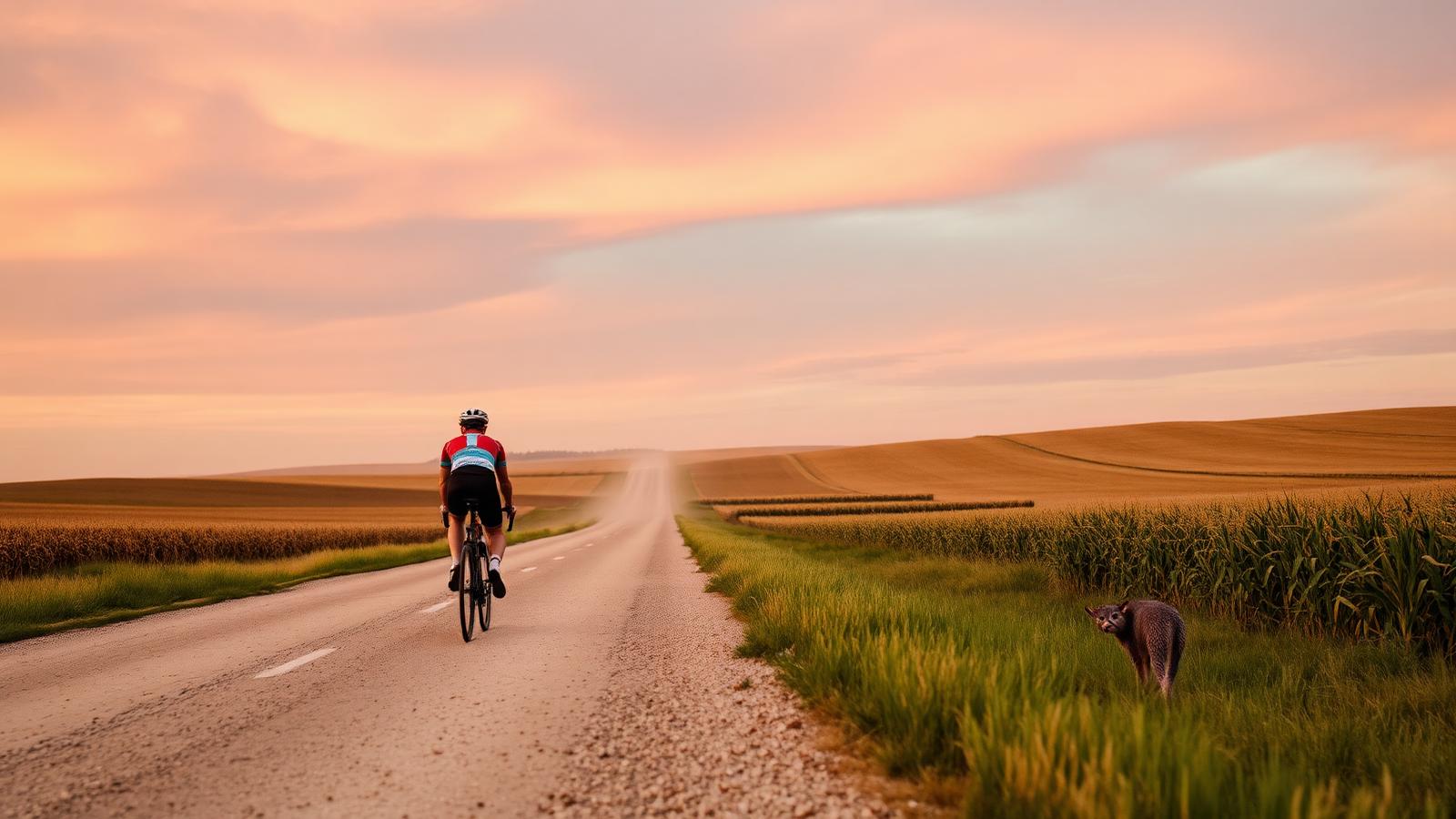
Lauf Gravel Worlds 2026 is a long, rolling gravel race based in Lincoln, Nebraska. The Gravel Worlds 150 is scheduled for Saturday, August 22, 2026. The organizer targets approximately 150 miles with more than 10,000 ft of climbing across rural gravel roads and rolling farmland in southeastern Nebraska. The 2026 route will be published approximately two to three weeks before race day; this guide is built around published distance and elevation targets, organizer guidance and historical course characteristics. This event is not the UCI Gravel World Championships.
Distance
≈ 150 miles main event · 300 · 75 · 35 mile options
Elevation
10,000+ ft (3,050+ m) of climbing on the 150
Typical duration
8 – 15.5 hours for most amateur finishers
Location
Lincoln, Nebraska, USA
Time of year
Race weekend August 19 – 23, 2026 (cycling races Saturday, August 22)
Terrain
Rural gravel roads and rolling farmland in southeastern Nebraska
Course map & elevation profile
The official Gravel Worlds course, elevation profile, and route reference. Use this to plan your pacing, aid-station strategy, and fueling touchpoints.
Gravel Worlds 150 — 2025 Route (reference for 2026)
Route shown is the 2025 edition of Lauf Gravel Worlds 150, used as reference for course profile, climbing pattern and checkpoint spacing. The 2026 route is released approximately two to three weeks before race day — confirm the final GPX, checkpoints and aid stations in the official 2026 athlete materials.
Download the Printable Gravel Worlds Race Guide
Get a practical planning document with the course breakdown, aid-station strategy, fueling and hydration worksheets, race-morning timeline, equipment checklist, crew notes, and space for your own plan.
10,000+ ft of climbing is delivered as repeated short rollers, not one defining mountain. Constant micro-efforts elevate carbohydrate use above what an equivalent flat 150-mile day would demand.
Sustained wind exposure
Southeastern Nebraska is open farmland with limited shelter. Sustained crosswinds and headwinds materially raise energy cost and change group dynamics for large portions of the day.
August heat and humidity
Historically possible: daytime highs in the 80s–90s °F (81–95 °F) with meaningful humidity. Sweat and sodium losses can be high; heat is a real planning variable, not a nice-to-have.
Thunderstorms and rain
Nebraska gravel can transform if rain hits — dust turns to slick clay-like mud that clogs frames and slows moving speed dramatically. Storm risk is real in August.
Long distance with wide checkpoint spacing
Organizer guidance currently places 150-mile checkpoints approximately around miles 60 and 110. Riders should plan for 3–5 hours of self-support between refills — verify in the 2026 athlete manual.
15.5-hour timing window
Official finish timing for the 150-mile event ends after approximately 15.5 hours (around 10:00 p.m.). Checkpoint cutoffs use an average minimum pace of approximately 9.5 mph (10 mph) — including stop time.
Late-race decision fatigue
Rolling terrain, wind, heat and long checkpoint gaps make the second half a decision-management race as much as a fitness race. Riders near the cutoff must budget stopped time carefully.
Finishing after dark
Slower finishers can arrive near sunset or after. Lights and reflective visibility should be planned for regardless of pace.
Course profile — segment by segment
A tactical breakdown of the Gravel Worlds course. Use this to plan pacing, fueling touchpoints and where to conserve versus commit.
Segment
Mile
Elevation
Note
Planning phase 1 — Start to ≈ mile 35
0 – 35
Rolling
Pacing objective: cap effort at endurance / high Zone 2. Fueling objective: start eating in the first 15 minutes and lock in a 15-minute alarm. Common mistake: chasing early moves and burning matches you will need after mile 100.Surface: Rural gravel (2026 route TBC)
Planning phase 2 — ≈ miles 35 – 70
35 – 70
Rolling
Approach and roll through the first planned checkpoint (organizer guidance: around mile 60). Objective: bank calories, top off bottles, protect the day. Common mistake: standing too long at the first stop and losing your group.Surface: Rural gravel
Planning phase 3 — ≈ miles 70 – 105
70 – 105
Rolling with sustained wind exposure
Middle of the race. Wind, heat and solo time dominate. Objective: steady fueling and disciplined pacing. Common mistake: chasing average speed on hard sections instead of protecting normalized effort.Surface: Rural gravel, farmland exposure
Planning phase 4 — ≈ miles 105 – 130
105 – 130
Rolling
Second planned checkpoint (organizer guidance: around mile 110). Objective: full reset, force calories even if appetite is gone, confirm cutoff margin, refresh sunscreen and lights setup. Common mistake: skipping this stop to save time and running dry in the final 30 miles.Surface: Rural gravel
Planning phase 5 — ≈ miles 130 – 150
130 – 150
Rolling to Lincoln finish
Final push. Objective: pace by HR or power, not by feel; save one gel for the last 30 minutes. Common mistake: assuming the finish is close and letting fueling lapse.Surface: Rural gravel to finish
Aid stations & crew strategy
Every aid station along the Gravel Worlds course, with crew access, drop-bag rules and the fueling action to execute at each stop.
Checkpoint 1 (provisional)
Mile ≈ 60
Primary refill and plan check. Top off bottles, take on 30–60 g CHO, salt tab if hot. Confirm location and services in the 2026 athlete manual.
Checkpoint 2 (provisional)
Mile ≈ 110
Final major refill and late-race reset. Force calories even if appetite is gone, confirm cutoff margin, refresh sunscreen, confirm lights are ready. Confirm in 2026 athlete manual.
Finish — Lincoln
Mile ≈ 150
Finish support. Confirm official timing and services in the 2026 athlete manual.
Fueling challenges & strategy
General, evidence-based guidance. Numbers should always be personalized to sweat rate, body mass, fitness and weather.
Carbohydrate strategy
Starting point: 70–100+ g/hr for trained athletes on a 150-mile race. Weight toward liquid and gel because rolling gravel limits when you can chew safely. Higher intakes require gut training and should be tested in representative long rides — do not introduce an aggressive target for the first time on race day.
Hydration
Build a fluid range around expected temperature, sweat rate, aid-station access and what you can carry, rather than a single universal number. Riders coming from cooler climates commonly underestimate August Nebraska fluid needs.
Sodium
Personalize based on measured or estimated sweat sodium, heat, products, and drinking rate. Long, hot exposure with wide checkpoint gaps makes cumulative sodium easy to under-plan.
Caffeine
Use only if practiced. Common approach for a 10–14 hour day: 100–200 mg pre-start, a mid-race dose, and a smaller dose in the last two hours. Total dose and timing should be based on your body mass and prior tolerance.
Checkpoint strategy
Plan every checkpoint on paper before race day: bottles in, bottles out, calories to grab, layers, sunscreen refresh, caffeine. A written card prevents multi-minute standing decisions. Confirm what neutral aid actually offers in the 2026 athlete manual.
Pre-race breakfast
1–4 g/kg carbohydrate 2–4 hours before the start, from familiar low-fiber, low-fat foods. Add 30–50 g CHO 15–30 minutes before the gun via a gel and sports drink. Rehearse the exact menu in training.
During-race execution
Fuel by the clock. Set a 15-minute alarm on your head unit from the neutral rollout. Front-load calories before every climb; sip on descents when the road allows.
Emergency backup
Carry 30–50% more calories than you plan to use. Wind, mud or a mechanical can add 60+ minutes to your day, and running out of fuel late is one of the top predictors of a missed cutoff.
Recovery
Within 60 minutes of finishing: 1.0–1.2 g/kg carbohydrate and 0.3 g/kg protein, plus fluid replacement to 150% of body-mass loss with sodium.
Carbohydrate loading for Gravel Worlds
A structured 48–72 hour carbohydrate-loading protocol tuned for a long day at altitude. Rehearse it before a training block, not for the first time on race week.
48–72 hours out
Target 8–10 g/kg body mass per day of carbohydrate from familiar low-fiber sources: rice, pasta, potato, bread, sports drinks, honey. Reduce fat and fiber to protect the gut on race morning.
Protein and fat
Keep protein moderate (1.2–1.6 g/kg/day). Reduce fat to ~0.5–0.8 g/kg/day. This is not the week for heavy sauces or fried foods.
Hydration and sodium
Drink to pale-yellow urine. Add 500–1,000 mg sodium per liter of fluid on the two days before the race — especially important given August heat and humidity.
Race morning
1–4 g/kg CHO 2–4 hours before the gun from familiar, tested foods. Oatmeal + banana + honey, bagel + jam or a rice bowl are proven. No experiments.
Sub-9 & sub-12 split targets
Aid-station splits for the two headline finish goals at Gravel Worlds: the Big Buckle (sub-9) and the Silver Buckle (sub-12). Use as planning anchors, not as commitments — weather, altitude adaptation and pack dynamics all shift real splits.
On rolling gravel, average speed is not constant. Normalized effort (or steady HR) protects glycogen and legs across hundreds of short rollers.
Rolling terrain and carb use
Repeated short climbs shift the day toward higher carbohydrate use than an equivalent flat 150-mile ride, even at the same average speed.
First third
Do not surge every riser. The field tends to accelerate hard in the first 30 miles; riding a step below that intensity is one of the highest-leverage decisions of the day.
Wind and group position
Sustained crosswinds and headwinds materially raise energy cost. Rotating in a disciplined group can save 15–30 minutes across the day — but chasing a group you cannot hold costs even more.
Average speed is not constant
Wind, heat, surface change, mechanicals and stop time can all take chunks out of your average. Plan by moving-speed range, not by a single number.
Checkpoint stops eat the moving-pace budget
The 15.5-hour timing window includes stopped time. Every minute at a checkpoint is a minute you must earn back on the bike.
Cutoff-adjacent riders
Riders near the cutoff need both a riding plan and a stop-time budget. Cap total stopped time to a written number — typically 20–40 minutes across the full day for cutoff-adjacent riders.
Equipment & bike setup
Gravel bike suitability
A dedicated gravel bike with clearance for 45 mm+ tires is the standard choice. Rehearse your setup on rides that mimic the expected duration and surface.
Tire width and casing
Most riders run 40–45 mm tubeless gravel tires with reinforced casings to trade rolling resistance against puncture protection. No single width is universally correct.
Tire pressure
Pressure depends on combined rider + bike mass, tire measured width, rim width, casing, inserts, surface, expected mud, rider handling and puncture risk. Test on similar terrain — do not debut a new pressure on race day.
Puncture kit
Tire plugs, at least one spare tube, CO₂ + inflator, mini pump backup, tire lever, chain quick link, multi-tool with chain breaker, spare derailleur hanger, valve core tool.
Hydration setup
Two large bottle cages minimum. Many riders add a top-tube feed bag; some 150-mile riders add a hydration pack or third cage when checkpoint spacing is long or forecast is hot.
Sun and heat
Sunscreen SPF 50+, lip balm with SPF, cap under the helmet, light-colored kit. Reapply at every checkpoint on hot days.
Lights
Front and rear light with charged backup power, plus reflective visibility. Any rider who may finish near or after sunset should treat lights as mandatory, not optional.
Weather layer
Based on the current forecast — a packable rain shell or gilet is a small weight penalty and a large safety benefit if storms roll through.
Identification and phone
Photo ID, race number, emergency contact taped inside a jersey pocket, phone with a backup battery.
Training for Gravel Worlds
Building your Gravel Worlds 2026 training plan
A realistic Gravel Worlds 150 training plan runs 12–16 weeks and builds three things in parallel: aerobic volume, rolling-terrain durability, and heat readiness. Most amateurs who finish inside the 15.5-hour window arrive at race week with a 10–15 hour peak, a longest ride of 6–9 hours on rolling gravel with 6,000+ ft of climbing, and 10–14 days of heat exposure in the final build. The bullets below are what actually works — not what looks impressive on Strava.
Volume ramp
Successful 150-mile finishers typically build to 10–15 hours per week for 10–14 weeks pre-race, with the final long ride 3 weeks out and a 2-week taper.
Long rides
Progress long rides toward 6–9 hours on rolling gravel with 6,000–9,000+ ft of climbing. At least two rides should closely mimic expected race conditions.
Threshold and tempo
Weekly threshold work (2× 20 min or 3× 15 min at 90–100% FTP) plus one long tempo block (60–90 min at 85%) for 8–10 weeks. Rolling gravel rewards steady sustainable power.
Rolling terrain simulation
One weekly session of repeated 3–8 minute rollers at tempo/threshold trains the exact energy system Gravel Worlds demands.
Gravel handling
One weekly ride on similar surface trains pack skills, cornering and line choice on loose gravel — especially important in wind.
Nutrition rehearsal
Every long ride is a fueling rehearsal. Target 70–100 g/hr of carbohydrate on 5+ hour rides to train the gut for race intake.
Heat preparation
10–14 days of heat exposure late in the build expands plasma volume and improves thermoregulation for August Nebraska conditions.
Race-day morning timeline
T-4 h
Wake, coffee, first breakfast (1–2 g/kg CHO) from familiar low-fiber foods. Hydrate 17 fl oz with sodium.
T-2 h
Second small feed (~50 g CHO). Chamois cream, sunscreen, kit on.
T-90 min
Bike check — pressure, brakes, computer, bottles loaded, top-tube bag stocked. Layer for expected start temperature.
T-45 min
Ride or drive to the corral. Sip 7–10 fl oz sports drink. Restroom.
T-20 min
First caffeine dose (if used). Final layering call. Confirm route sync on the head unit.
T-5 min
Half a gel. Breathe. Confirm HR/power start plan with yourself.
Gun
Rollout. Start times: elite men 6:25 a.m., elite women 6:35 a.m., general field 7:00 a.m. Cap effort in the first hour — do not chase early moves.
Every entry route into the Gravel Worlds, from the annual lottery to qualifier races, coaching-program slots and charity entries.
Official registration
Register through the official Gravel Worlds website. Distances offered: Gravel Worlds 300, Gravel Worlds 150, Gravel Worlds 75 and Gravel Worlds 35. Confirm current-year process, pricing and deadlines on gravel-worlds.com.
Choose the right distance
Gravel Worlds 35 is noncompetitive with one planned checkpoint. Gravel Worlds 75 (~5,000 ft) is a solid step up. Gravel Worlds 150 is the flagship — plan for 8–15+ hours. Gravel Worlds 300 is for experienced ultra-distance riders.
Getting there, lodging & logistics
Airports, lodging, packet pickup, parking and crew access for the Gravel Worlds.
Getting there
Lincoln, Nebraska (LNK) offers regional service; Omaha (OMA) is roughly 60 minutes by car with broader flight options. Rent a car — there is no meaningful public transit to the start area or checkpoints.
Lodging
Downtown Lincoln hotels and short-term rentals within a short drive of the start/finish. Book early once the athlete manual confirms start location and logistics.
Packet pickup
Held on the days before the race per the athlete manual. Attend any pre-race briefing — course changes and safety notices are announced there.
Parking and start line
Confirm parking and start-line logistics in the 2026 athlete manual as soon as it is released.
Crew and outside assistance
Verify current-year crew, drop-bag and outside-assistance rules in the 2026 athlete manual before planning support.
What most riders get wrong
01
Surging in the first third
Rolling terrain encourages riders to attack every riser. Repeated over-threshold efforts in the first 50 miles burn glycogen you cannot replace and set up a bad last quarter.
02
Under-carrying fluid between checkpoints
With checkpoints planned around miles 60 and 110, a single bottle empties in 60 minutes and leaves hours dry. Plan for what you carry, not what you hope to find.
03
Ignoring wind in the pacing plan
Solo into a Nebraska headwind can cost 2–4 mph vs. a rotating group. Choosing when to sit in and when to work is a race-defining decision.
04
Underestimating August humidity
Sweat and sodium losses can be much higher than the air temperature suggests. Riders arriving from dry or cool climates commonly under-plan fluid and sodium.
05
New products or new setup on race day
Long time-on-course amplifies GI risk. Race only what you have trained with — nutrition, tires, pressure, saddle, shorts.
06
No lights for a late finish
Mid- to back-of-pack riders can arrive near or after sunset. Lights are a safety item, not an optional accessory.
07
No stop-time budget
The 15.5-hour timing window includes stopped time. Riders near the cutoff who spend 15 minutes at each checkpoint eat their entire margin at the aid stations.
08
Treating 2025 route info as 2026 fact
The 2026 course will be released two to three weeks before race day. Do not plan checkpoint mileage, climbs or aid location off the prior year — confirm from the 2026 athlete materials.
Race history & culture
Long-running Nebraska gravel
Gravel Worlds has been a fixture of the American gravel scene for over a decade, based out of Lincoln, Nebraska, and organized by Goodlife Adventures / the Pirate Cycling League.
Lauf title partnership
Recent editions have been branded as Lauf Gravel Worlds under the Icelandic bike brand's title sponsorship.
Not the UCI Gravel World Championships
Despite the name, Gravel Worlds in Nebraska is not the UCI Gravel World Championships. It is an independent event with its own identity, culture and course.
Why generic fueling plans don't work for Gravel Worlds
Two riders on the same start line can need very different fueling. FTP, target finish time, body mass, sweat rate, temperature, altitude adaptation, nutrition products and race goals all change the answer. A generic 60 g/hr recommendation is a starting point, not a plan.
FTP
Finish time
Body weight
Sweat rate
Weather
Products
Goals
Course
Related FuelQ resources
Free calculators, checklists and articles to help you personalize your Gravel Worlds plan.
Get a practical planning document with the course breakdown, aid-station strategy, fueling and hydration worksheets, race-morning timeline, equipment checklist, crew notes, and space for your own plan.
A Race Fueling Plan gives you a personalized strategy for this event. The free checklist helps you prepare the basics first: race-week setup, 48-hour prep, race morning, hydration, sodium, caffeine, aid stations, and backup calories.