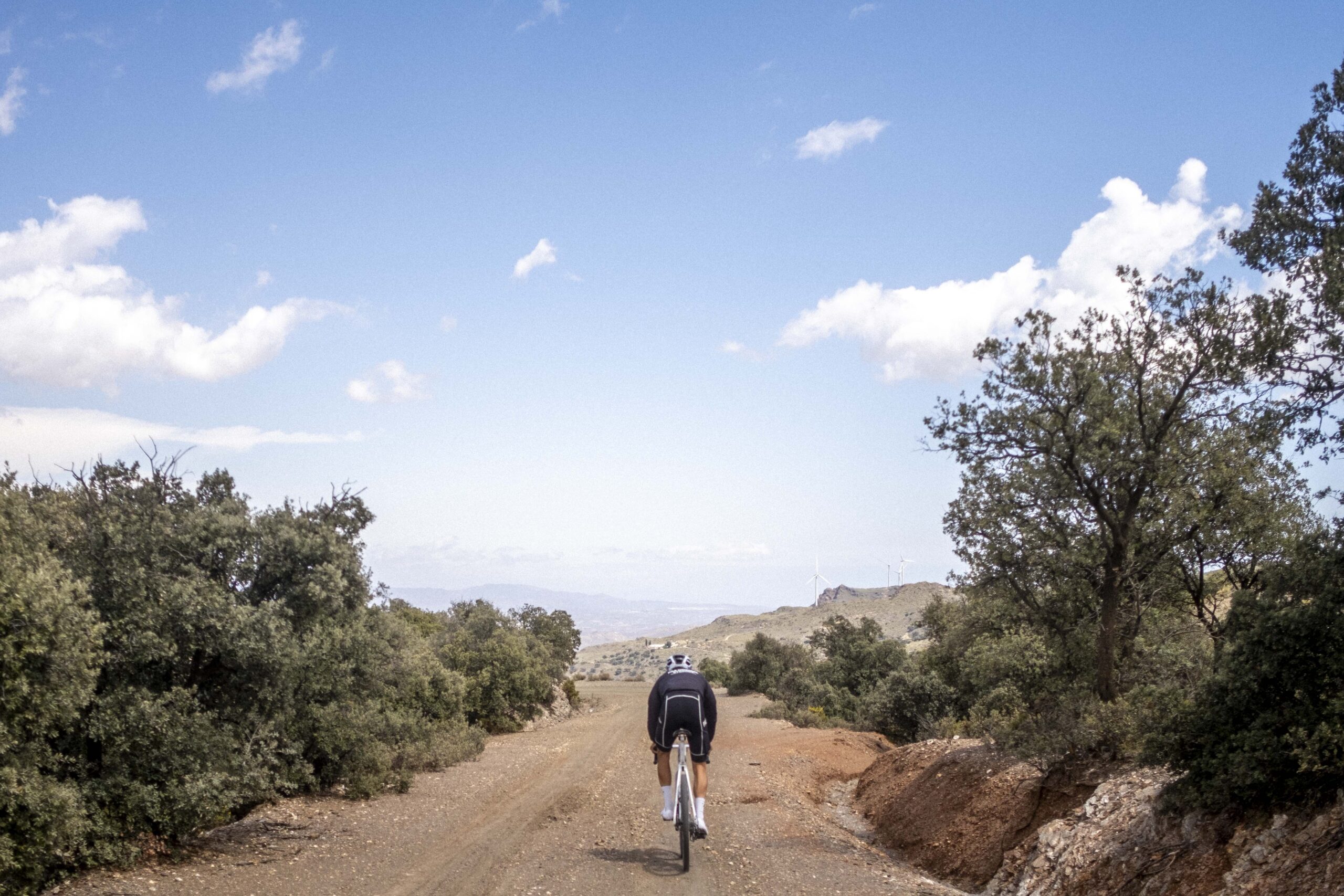
Badlands — a 466 mi self-supported ultra-gravel race across Andalusia, from Granada through the Sierra Nevada and the Gorafe desert to the Almería coast, held late August each year.
Badlands is a self-supported ultra-distance gravel race that crosses the Sierra Nevada and the Gorafe Desert — the only true desert in continental Europe — over roughly 466 mi with ~49,210 ft of climbing. From Granada in the west to the Cabo de Gata coast on the Almería side, the route strings together high-mountain fire roads, dry riverbeds, exposed desert doubletrack and long empty stretches with no resupply. Extreme late-summer heat, minimal sleep and total self-sufficiency make it as much a logistics and decision-making problem as a fitness one.
The Badlands organizer publishes route references on Komoot rather than RideWithGPS. These embeds show signature segments of the late-race Almería crossing — Tabernas Desert and Campo de Tabernas — as references so you can preview the terrain, gradient and exposure. The full official Badlands 750 GPX is released by the organizer at badlands.cc to registered riders 4–8 weeks before the race and is not made public. Badlands typically changes 10–20% of the course year to year to protect the terrain and adapt to access. Course details, mandatory waypoints and any last-minute reroutes are confirmed only at the pre-race briefing.
Download the free printable race-day fueling checklist for Badlands
A practical race-week checklist: carbs, hydration, sodium, caffeine and race-day supplies — print it or keep it on your phone.
Daytime temperatures in the Gorafe and Tabernas desert regularly exceed 100 °F in the shade and 113–122 °F on radiating rock. Sweat losses over 51 fl oz/hr are common and sodium demand climbs proportionally. Night-riding to skip the worst 11:00–17:00 window is a mainstream tactic, not an emergency measure.
Total self-support
There are no course-provided aid stations, no drop bags and no mechanical assistance. Every calorie, litre of water, tube and spare part is either carried, bought at a village shop / gas station, or filled at a fountain (fuente) marked on the roadbook. Third-party support outside official checkpoints is a DQ.
Long resupply gaps
Sections of the Gorafe, Almería badlands and Sierra de los Filabres string together 37–75 mi with no reliable water. Miscalculating the last-fill window is the classic Badlands DNF, especially in the second day when fatigue clouds arithmetic.
High-altitude Sierra Nevada crossings
The route climbs sections of the Sierra Nevada above 6,560 ft — including passes near Ragua and Trevélez — on rough fire road. Cold night temperatures above 6,560 ft can drop to 41–50 °F even in August, layered on top of desert-day heat 12 hours earlier.
Ultra sleep debt
By night 2–3 the cognitive fog is measurable: reduced fine motor control, worse fueling decisions, hallucinations on long moonless stretches. Structured 2–4 hr sleeps at planned villages beat one longer late push for most riders.
Technical rough gravel & ramblas
This is not smooth ranch gravel — expect broken shale, loose baby-heads and dry riverbeds with soft sand traps. Tyre choice, casing and pressure matter as much as fitness. A single sidewall cut can end a race 124 mi from the next bike shop.
Navigation & isolation
GPX-only navigation with intermittent phone signal. Getting off-route in the Sierra de Baza at night, low on water, is a real safety problem — not a cosmetic time penalty.
Fueling challenges & strategy
General, evidence-based guidance. Numbers should always be personalized to sweat rate, body mass, fitness and weather.
Carbohydrate strategy
For a 3–6 day ultra, 40–70 g/hr of a mix of real food (bocadillos, bananas, dried fruit) and sports nutrition (gels, drink-mix, chews) is more sustainable than sprint-race intake. Bias sports products for the first 12 hours when the gut can still tolerate them; rotate to more real food from day 2 onward as flavour fatigue and GI stress build.
Hydration
In Gorafe heat, 24–51 fl oz/hr on the bike + another 34–101 fl oz consumed at every resupply. Carry 135–203 fl oz of on-bike capacity for the biggest gaps (2× 34 fl oz bottles + 2× soft flasks in a hip pack + a 68 fl oz bladder is a common Badlands setup). Refuse to leave a resupply without every container topped up, even if the next one 'should' be close.
Sodium
600–1,500 mg/L of fluid, tuned to sweat testing in similar heat. Cumulative sodium deficit is the classic desert-race collapse — muscle cramping, nausea, dizziness on climbs. Salt caps or high-sodium electrolyte tabs let you dose independently of drink-mix flavour fatigue.
Caffeine
Rotate low-dose and high-dose blocks across the race to preserve responsiveness. Typical daily intake 200–600 mg, timed for pre-dawn starts and the mid-afternoon low. Skip caffeine entirely for one 8-hour window every 24 hours to protect the response for the moments that decide finishing.
Resupply strategy (there are no aid stations)
The entire race runs on public infrastructure: village shops (tiendas), gas stations, bars/venta with menú del día, and marked fountains. Pre-load a resupply map on your GPS the week before the race — village name, distance from the previous, opening hours (many close 14:00–17:00 for siesta), water reliability. Never leave a resupply that has functional water without full bottles.
Pre-race breakfast (and pre-departure meal each morning)
1–3 g/kg carbohydrate 2–3 hours before rolling out, from rehearsed foods that sit well in heat: oatmeal + honey + banana, white bread with jam, rice pudding, sports drink. Avoid high-fibre and high-fat first thing when heart rate spikes on the first climb.
During-race execution
Alarm-based fueling every 20–30 minutes on the bike whether you feel like it or not — thirst and hunger cues are unreliable at hour 30+. Log every intake on your head unit or a wrist note to catch drift before it becomes deficit. Eat real hot meals at bars/ventas whenever the timing allows to protect gut function.
Recovery (each sleep is a mini-recovery)
Every off-bike stop over 30 minutes is a recovery window: 1.0 g/kg carbohydrate + 0.3 g/kg protein + 17 fl oz water with sodium before sleep. A cold shower or river dunk to drop core temperature significantly improves sleep quality in the desert.
Fueling timeline by phase
Grams and millilitres per hour for each phase of the race. Personalize to your sweat rate, body mass and conditions.
Badlands 466 mi · phased by day for a 4-day mid-pack finisher
Pre-race breakfast (T-3 h to T-30 min)
Granada start·3 h before roll-out
Carbs
1–3 g/kg body mass (rehearsed)
Fluids
17–27 fl oz with 500–800 mg sodium
Sodium
500–800 mg
Caffeine: 100–200 mg 30 min pre-start
Focus: Familiar foods only. Bread + jam + banana + coffee is safer than anything novel. Empty the bladder twice before rolling.
Focus: Race-format fueling while the gut is fresh. Big climb into Sierra de Huétor early — do not chase groups above your zone 2 HR. Rehearse a full resupply stop (village bar): 2 bottles refilled, 1 hot Coke, 1 sandwich packed for the next 90 min.
Day 1 night — first sleep window
124–174 mi·Hour 12 → 18
Carbs
40–60 g/hr on the bike + real meal at sleep stop
Fluids
17–24 fl oz/hr
Sodium
500–800 mg/L
Caffeine: None from 4 hours before planned sleep
Focus: Choose a planned village (Guadix, Gor or similar based on your pace). Real hot meal + shower + 3–5 hr sleep. Kit dries overnight. Set two alarms.
Focus: The signature day. Start pre-dawn to bank distance in cool air. Full 169–203 fl oz on-bike capacity leaving the last village before Gorafe. Force intake by alarm — appetite is dead by mid-afternoon. Night ride the last 25 mi if daytime heat is over 104 °F.
Day 3 — Sierra de los Filabres & Almería badlands
261–360 mi·Hour 40 → 65
Carbs
40–60 g/hr (accept lower gut tolerance)
Fluids
34–44 fl oz/hr
Sodium
700–1,100 mg/L
Caffeine: Skip morning caffeine one day per race to reset responsiveness
Focus: GI resilience matters more than peak intake now. Rotate to more real food (bread + cheese + cured meat + fruit). Second structured sleep 3–5 hours at a planned pueblo. Ferritin-low riders start feeling altitude cumulatively — pace by HR, not power.
Day 4 — Tabernas & Cabo de Gata to finish
360–466 mi·Hour 65 → finish
Carbs
50–70 g/hr (protect final push)
Fluids
34–51 fl oz/hr
Sodium
800–1,200 mg/L
Caffeine: 150–250 mg for the final push once you can smell the sea
Focus: Tabernas desert is exposed and hot even mid-morning. Coastal wind can be brutal in the last 37 mi. Do not skip the final resupply — the finish 'feels' close and riders under-drink the last 3 hours and cramp on the beach.
Recovery (T+0 to T+24 h post-finish)
Finish line·First 24 h after crossing the line
Carbs
1.0–1.2 g/kg within 60 min, then 8–10 g/kg over 24 h
Fluids
150% of estimated body-mass loss with sodium
Sodium
3,000–5,000 mg cumulative day 1 post-race
Focus: Cold shower first, then real meal (paella + patatas bravas + Coke). Sleep priority over 'refuelling correctly'. Ferritin, vitamin D and iron check 7–10 days after the race, not immediately.
Numbers assume a 3.5–4 day finisher in typical late-August heat (95–108 °F days, 59–68 °F nights above 4,920 ft). Faster riders compress phases; slower riders extend day 2 into 3 and add a third sleep. Individual sweat rate can shift fluid and sodium targets by ±30% — personalize with a pre-race sweat test in similar conditions.
Carbohydrate loading for Badlands
A structured 48–72 hour carbohydrate-loading protocol tuned for a long day at altitude. Rehearse it before a training block, not for the first time on race week.
3-day pre-race carb load protocol
For 2–3 days before the race, target 8–10 g/kg body mass per day of carbohydrate from familiar low-fibre sources: white rice, pasta, potato, bread, sports drinks, honey, jam. Reduce fat and fibre, keep protein moderate (~1.2 g/kg), hydrate steadily with 500–800 mg sodium per L of water. Do not experiment — race the loading foods you have tested.
Loading foods that travel well to Spain
If you cannot cook, buy at any Spanish supermarket: white rice, spaghetti, white bread, honey (miel), jam (mermelada), banana (plátano), potatoes (patatas), sports drink powder (isotonic packs are widely available). Avoid experimenting with jamón, chorizo or cheese as loading foods — they are Spanish, but they are high-fat and low-carb.
Hydration & sodium in the final 72 h
Drink 101–135 fl oz per day of water with 3,000–5,000 mg sodium total. Underhydration before the start compounds through day 1 heat. Aim for consistently clear-to-pale-yellow urine every 2–3 hours during the 24 hours pre-race. Alcohol is a hard no for the final 72 hours.
The night-before dinner
Eat by 19:00 if possible — a big late dinner disrupts sleep and gastric emptying. Familiar low-fibre, low-fat plate: white pasta with light tomato sauce + white bread + small salad + banana + honey + rice pudding for dessert. Skip protein-heavy or fatty meat dishes.
Race-morning breakfast
3–4 hours pre-start: 1–3 g/kg CHO from rehearsed foods — oatmeal + honey + banana + white bread + coffee + 17 fl oz sports drink. 90 min pre-start: small top-up (~50 g CHO), bread + jam + water. 30 min pre-start: half a gel + 7 fl oz water + first caffeine dose.
Pacing strategy
Day 1 = don't dig a hole
The first 8 hours feel great and set the trap for the whole race. Cap effort at high zone 2 heart rate (or ~65–72% of your fresh FTP). Riders who chase groups out of Granada pay the price 311 mi later in the Gorafe. Discipline > enthusiasm.
Ride the cool hours, sleep the hot hours
In peak heat (14:00–17:00, 40+ °C), a shaded 60–90 min break in a venta with cold drinks and a nap does more than pushing through. Night ride to compensate — the pre-dawn hours (04:00–08:00) are the coolest and most efficient.
Sierra Nevada — climb by HR, not power
Above 6,560 ft, power at a given heart rate drops 5–10%. Pace by heart rate or perceived effort, not by fresh-day FTP numbers. Bailing out of a Sierra climb because you overcooked the first 30 min costs 60–90 min in a nowhere-village recovery.
Gorafe crossing — bank distance in cool air
Start the biggest desert gap at 04:00–05:00 and aim to be through the worst 37–75 mi stretch by 11:00. If daytime heat forces a stop, hold in shade until 17:00 and finish the crossing at dusk. Fighting the peak sun in the Gorafe is a race-ender.
Manage every resupply like a pit stop
Every village stop is 20–45 minutes: fill every container, hot food, refill electrolyte, check tyres, oil chain if dry, reapply sunscreen, restart alarms. Standing decisions ('what should I buy?') are the enemy — pre-plan the resupply sequence for every stop the night before.
Second-half discipline
By day 3 the temptation is to 'just push to the finish'. This is when GI collapse, sleep-deprived crashes and hypothermic descents happen. Keep the same structured 3–4 hr sleep, same 30-min alarm fueling, same shade stops. Discipline finishes Badlands; ambition scratches.
Final push — cold Coke discipline
The Cabo de Gata coast feels close from 37 mi out but the wind is real and the heat radiates off the beach approach. Take the final full resupply on principle. Save 200 mg of caffeine for the last 3 hours. Cross the line, then celebrate — do not celebrate 25 mi out.
Equipment & bike setup
Bike choice
A rigid drop-bar gravel bike with wide tyre clearance (48 mm minimum, ideally 53–55 mm) is the mainstream Badlands platform. Some riders run drop-bar hardtails (Salsa Cutthroat, Kona Sutra Ultd) or even short-travel MTBs with aero bars. A rigid gravel frame with fast-rolling 45–50 mm tyres is the sweet spot — fast enough on smooth sections, capable on the rougher Sierra Nevada fire roads.
Tyre width & casing
45–50 mm tubeless with reinforced casing (Vittoria TerraSpeed XC-Race, Panaracer GravelKing SK+, René Herse Standard). Fast-rolling file or moderate tread over aggressive knobs — most terrain is rock and shale. Casing durability trumps weight — a single sidewall cut can end a race 124 mi from the next bike shop. Carry 2 tubes and 2 tyre plug kits.
Tyre pressure
As a starting point for a 154–176 lb rider on 25 mm internal rims: 24–28 psi front, 26–30 psi rear. Lower for smooth desert gravel; higher for the rocky Sierra Nevada descents. Always dial pressure in heat — hot rims can add 2–4 psi over the day.
Gearing
A 40–42t front chainring paired with an 11-speed 11–46t or 12-speed 10–52t cassette gives most riders a bail-out for the 15% Sierra pitches. Elite riders often go 42–44t front. Avoid a 1× setup with less than 500% range for the biggest climbs.
Brakes
Hydraulic disc brakes with 160 mm rotors front and rear. Fit fresh pads race week and bed them in on a training ride before the race. Descending 49,210 ft in dust and heat wears pads fast — carry 2 spare pads in your repair kit.
Bags & storage
Frame bag + top-tube bag + rear seat pack (Apidura, Restrap, Ortlieb) is the mainstream Badlands setup. Total capacity ~507–676 fl oz. Do not bring a rucksack — heat trapped against your back on 104 °F climbs is a race-ender. A hip pack with 2 soft flasks + one small pouch is a lighter alternative that some riders prefer.
Hydration setup
2× 34 fl oz bottle cages in the main triangle, 2× 17–25 fl oz soft flasks in a hip pack or top-tube bag, plus a 51–68 fl oz hydration bladder in the frame bag or a bikepacking-specific back-mounted bladder for the biggest desert gaps. Total on-bike capacity: 135–203 fl oz. A stainless-steel Nalgene as backup for filling at questionable fuentes and boiling water later.
Lights & electronics
Two front lights (main + backup, 1,000+ lumen main, USB-C rechargeable), a rear light with race-legal always-on mode, a head torch for camp and repairs, and a dynamo hub (SON or Shutter Precision) with cache battery for indefinite USB charging on the move. GPS: two devices (main head unit + backup — a phone in airplane mode with OsmAnd or Komoot offline works).
Spares & repair kit
Minimum: 2× tubes, 2× tyre plug kits, tyre boots, chain quick link (2), multi-tool with chain breaker, spare derailleur hanger, spoke wrench + 3–4 spare spokes taped to a chainstay, 2 sets of brake pads, 1 spare cleat, small tube of chain lube, dynamo hub grease, zip ties + electrical tape. A backup rear derailleur cable if you run mechanical shifting.
Clothing
Bib shorts (2 pairs to swap at a sleep stop), UPF-rated sun sleeves, cycling cap under the helmet, cycling socks (2 pairs), lightweight rain jacket, lightweight puffer or fleece for Sierra Nevada nights, buff for neck/face sun protection, cycling gloves, sunglasses with photochromic lens for cave-to-sun transitions. All black is a mistake — go for high-visibility colours for road sections.
Training for Badlands
Building your Badlands ultra training plan
A realistic Badlands ultra training plan runs 20–32 weeks and builds five things in parallel: aerobic volume, back-to-back long-ride capacity, heat tolerance, gut trained for 60–90 g/hr, and sleep-deprivation experience. Most amateurs who finish arrive at race week with a 15–20 hour peak, a longest ride of 300+ km with real bikepacking load, and at least one training block that included 24+ hours of continuous riding with 3–4 hours of sleep in the middle.
Volume ramp
Build to 15–20 hours per week for 10–14 weeks before race week, with the final long back-to-back block 3 weeks out and a proper 2-week taper. Volume matters more than intensity for Badlands — you cannot brute-force ultra fitness with intervals.
Long back-to-back rides
Every 2–3 weeks in the final 12 weeks: a Saturday 124–186 mi ride at Badlands pace, sleep 4–6 hours, then a Sunday 93–124 mi ride at endurance pace. This teaches the body to fuel and recover between big efforts and identifies gut, kit and setup problems while there is still time to fix them.
Heat acclimatization
10–14 heat sessions (sauna 20–30 min post-easy-ride, or indoor trainer in a warm room 45–60 min at moderate effort) in the 6 weeks pre-race. This expands plasma volume ~5–10%, lowers core temperature at a given power, and improves sweat-sodium efficiency. If possible, book a 5–7 day training trip somewhere ≥90 °F in the 4 weeks before the race.
Gut training
Every long training ride is a fueling rehearsal. Progress from 40 g/hr in early build to 60–90 g/hr sustained on rides over 4 hours. On the longest training rides (200+ km), practice the full Badlands fueling loop: alarm-based intake, resupply stops with hot food, and real drink-mix concentrations. GI training takes 8–12 weeks — start it early.
Sleep-deprivation rehearsal
At least one training block should include a 22:00 → 02:00 night ride followed by 3 hours of sleep and a 05:00 restart. This rehearses navigation under fatigue, cognitive fueling drift, and the psychological experience of getting on the bike when the body wants to sleep. Do this at least 6 weeks out — do not test it for the first time on the race.
Climbing-specific work
Prescribe at least one sustained climb per week of 45–90 minutes at low tempo (zone 2 heart rate, not threshold). Badlands climbing is long, hot and low-intensity, not short and explosive. If you cannot find a climb, use a smart trainer with an incline profile for 60–90 min.
Descending & handling skills
Loaded bikepacking bikes descend and corner differently from unladen ones. Do at least 4–6 long training rides with your full race bag setup so you learn how the bike behaves in real gravel corners, on washboard descents and in soft sand. Dropping a fully loaded bike at km 400 of Badlands can end a race.
Iron, ferritin & pre-race blood work
Test ferritin 12–14 weeks out — below ~40 ng/mL for women or ~50 for men blunts aerobic performance and heat adaptation. Low iron is the most common under-diagnosed cause of underperformance in ultra riders. Correct with diet and (if a doctor confirms) supplementation in the 8–12 weeks before the race.
Race-day morning timeline
T-72 h to T-24 h (3 days out to 1 day out)
Carb load: 8–10 g/kg CHO per day from low-fibre familiar foods. Reduce alcohol to zero. 101–135 fl oz water per day with 3,000–5,000 mg sodium. Final bike check + full pack weigh. Kit briefing with any pair partner.
T-24 h (day before)
Attend the pre-race briefing at the start village. Confirm final route, mandatory waypoints, cutoff and any late course changes. Eat dinner early (18:00–19:00), rehearsed foods only. Kit laid out. Alarm test. Bed by 21:00.
T-4 h (typical 04:30 wake for 08:30 start)
First breakfast: oatmeal + banana + honey + coffee. Hydrate 17 fl oz with sodium. Chamois cream. Kit on.
T-2 h
Second small feed (~50 g CHO): bread + jam + sports drink. Final bag check. Tracker on and verified. Layer up for start temperature.
T-90 min
Bike check: tyre pressure, brakes, GPS route loaded, lights charged, bottles filled and mixed. Ride to the start village if not already there.
T-30 min
In the start pen. First caffeine dose (100–200 mg). Restroom. Final layering call for Sierra crossing later in day 1.
T-5 min
Half a gel. Confirm heart-rate cap for the first hour. Breathe. Wave off anyone who wants a photo — save the phone battery.
T+0 (typically 08:30 start)
Roll out. Do NOT chase groups. Ride the first hour at high zone 2 HR whether the group in front is going faster or not.
Packing list
Bike
Race bike (fully serviced 2 weeks out)
Two large bottle cages in main triangle
Frame bag + top-tube bag + seat pack (~507–676 fl oz total)
Two GPS devices (main + phone backup)
Two front lights + one rear light + head torch
Dynamo hub + cache battery
Nutrition (3–4 days on route)
Gels / chews / drink mix for 24 h + 30% buffer
Salt caps (2× daily allowance)
3–4 real-food emergency bars
Caffeine tablets or gels (200–400 mg reserve)
Instant coffee sachets
Ice-cream + cold Coke budget (mid-afternoon heat)
Hydration
2× 34 fl oz frame bottles
2× 17–25 fl oz soft flasks (hip pack or bar bag)
51–68 fl oz hydration bladder
Stainless-steel Nalgene backup for filling at questionable fuentes
Water purification tablets (backup)
Electrolyte tabs for pre-mixing (700–1,200 mg/L)
Clothing
2× bib shorts (swap at sleep stop)
1× jersey
UPF sun sleeves
Cycling cap under helmet
Buff (neck + face sun protection)
2× cycling socks
Lightweight rain jacket
Lightweight puffer or fleece (Sierra nights)
Cycling gloves + full-finger optional
Photochromic sunglasses
Sleep kit
Lightweight bivy bag or emergency space blanket
Silk sleeping bag liner (for hostal beds)
Inflatable pillow
Ear plugs + eye mask
Small quick-dry towel
Tools & spares
2× tubes
2× tyre plug kits + tyre boots
Multi-tool with chain breaker
2× chain quick links
Spare derailleur hanger
Spoke wrench + 3–4 spare spokes taped to chainstay
2 sets brake pads
Small tube of chain lube
Zip ties + electrical tape
Small first-aid kit (blister patches, ibuprofen, chamois cream, anti-chafe balm)
Every entry route into the Badlands, from the annual lottery to qualifier races, coaching-program slots and charity entries.
How to enter Badlands
Registration opens in December-February for the following August edition on badlands.cc. Not lottery-based, but with defined field size and typically sells out within days. Riders submit an ultra-cycling experience declaration; the organizer reserves the right to decline entries without documented ultra experience for safety reasons.
Entry fee
Recent editions have run approximately 350–450 EUR. Includes GPX release, roadbook, race number, tracker rental (or deposit), pre-race briefing and finish services. Does not include lodging, food, flights or bike travel.
Solo vs pair category
Solo (fully self-supported individual) or Pair (two riders, matched pace, self-supported as a unit). Pair riders must stay within visual distance for the entire race and cross the finish line together. Both categories share the same course and cutoff.
Cancellation & refund policy
Refunds up to a published deadline (typically 60–120 days pre-race). Late cancellations receive partial or no refund. Confirm the current-year policy in the registration terms — the organizer publishes them alongside the entry form.
Insurance requirement
Riders must carry personal cycling / travel insurance that covers ultra-cycling events. This is checked at registration. UK riders typically use CTC / British Cycling; EU riders through FFC / Federazione or local equivalent; international riders through World Nomads or specialist ultra-cycling insurers.
Getting there, lodging & logistics
Airports, lodging, packet pickup, parking and crew access for the Badlands.
Getting there — Granada (start)
Granada Airport (GRX) is 20 min from the city with direct flights from Madrid, Barcelona and select European hubs. Málaga (AGP) is 90–120 min by car with far more international connections and often cheaper bike-travel fees. Bus from Málaga to Granada runs frequently and accepts bike boxes. Train (Renfe) between Málaga and Granada is bike-friendly with reservation.
Getting back — Almería (finish)
Almería (LEI) is the closest airport to the finish for the return leg, with direct flights to Barcelona, Madrid and some European cities. Alternative: bus from Almería back to Granada (~3 hr) or Málaga (~4 hr) and fly out from there — often cheaper and easier for large bike bags.
Bike travel
A hard case (Bike Box Alliance, Scicon Aerocomfort) is safer for Badlands travel than a soft bag — you will not have a car to bring it back to. Ryanair, Vueling, Iberia and easyJet all fly the Málaga / Granada / Almería routes; check current bike bag policies (weight + linear-dimension limits) 8 weeks before booking.
Pre-race lodging in Granada
Old Town (Albaicín, Realejo) is 15–20 min ride to the traditional start village and packed with pre-race dinner options. Bike-friendly hotels: Casa 1800, Palacio Santa Inés, or short-term rentals with private ground-floor bike storage. Book 4–6 months in advance for late-August availability.
Post-race lodging near the finish
Cabo de Gata (San José, El Cabo de Gata pueblo) is 30–60 min from the finish and offers cold beaches for recovery. Almería city (Casco Antiguo) is closer to the airport for early flights. Book both pre-race and post-race lodging before you leave home — post-race brain fog will make it a nightmare to arrange.
Pre-race briefing & tracker pickup
The pre-race briefing is mandatory and held at the start village 12–24 hours before the roll-out. Tracker rental (or refundable deposit) is collected at the same time. Missing the briefing invalidates your entry. Plan to arrive in Granada by the morning of the day-before at the latest — earlier is better for acclimatization.
Weather contingency
The race runs in nearly any weather but the organizer has neutralized or cancelled editions mid-race in extreme conditions (2022 wildfire cancellation). Pack a lightweight rain jacket even for a 'sunny' late-August start — thunderstorms in the Sierra Nevada above 6,560 ft are a real risk.
What most riders get wrong
01
Racing it like a one-day event
Sprint-race fueling volumes (>90 g/hr indefinitely) break the gut within 24 hours in desert heat. Ultra fueling has to be sustainable for 3–6 days, which means lower peak carbs and more real food.
02
Under-carrying water into the Gorafe
Desert resupply gaps in the Gorafe crossing are unforgiving. Riders drop out because bottles run dry between villages, not because they cannot drink. Every fuente-marked stop should top off every container even if the next 'should' be soon.
03
Ignoring sodium
In Gorafe heat, sodium deficit is the classic cause of cramping, nausea and DNF. Water without sodium at 51 fl oz/hr sweat rate accelerates the problem — dilutional hyponatremia is a real risk, not a theoretical one.
04
Sleeping too little
Cognitive fog wrecks navigation, fueling decisions and safety on technical descents. Two structured 3–4 hr sleeps beat one 6-hr late push for most riders. Sleep deprivation is why leaders DNF, not why they finish first.
05
New foods, kit or shoes on race day
Unfamiliar shop food in extreme heat is a fast route to GI collapse. Unfamiliar chamois after 20+ hours in the saddle is a race-ender. Rehearse the entire kit on training rides of 200+ km in comparable heat before you commit.
06
No caffeine rotation plan
Constant caffeine over 3–5 days causes tolerance drift and worse late-race responsiveness. Deliberately rotate lower-dose days and skip 8-hour caffeine windows to keep the response sharp for the moments that decide finishing.
07
Riding through the 14:00–17:00 heat peak
Daytime highs of 104–113 °F during the peak 3-hour window destroy multiple days of energy. Planned siesta stops in shaded venta or shops (they close 14:00–17:00 anyway) preserve gut function and evening pace. Night riding to compensate is a mainstream Badlands tactic.
08
Underestimating night cold in the Sierra Nevada
Sub-50 °F temperatures above 6,560 ft at 03:00 catch riders who packed for the desert and forgot the mountain. A lightweight jacket, buff and long fingers weigh nothing and prevent a hypothermic bailout.
09
Skipping the final resupply near the coast
The Cabo de Gata finish feels close from 25 mi out. Riders under-drink the last 3 hours, hit the coast in a strong wind, and cramp within 6 mi of the finish. Take the last full resupply on principle.
Why generic fueling plans don't work for Badlands
Two riders on the same start line can need very different fueling. FTP, target finish time, body mass, sweat rate, temperature, altitude adaptation, nutrition products and race goals all change the answer. A generic 60 g/hr recommendation is a starting point, not a plan.
FTP
Finish time
Body weight
Sweat rate
Weather
Products
Goals
Course
Related FuelQ resources
Free calculators, checklists and articles to help you personalize your Badlands plan.
Every athlete is different. FTP, finish time, body weight, sweat rate, weather, nutrition preferences and race goals all change what you should eat and drink.
FuelQ Pro builds a personalized race fueling strategy tuned to your ride — carbohydrate, hydration, sodium, caffeine and recovery, mapped to the course.
A Race Fueling Plan gives you a personalized strategy for this event. The free checklist helps you prepare the basics first: race-week setup, 48-hour prep, race morning, hydration, sodium, caffeine, aid stations, and backup calories.